AC Contactor vs. Capacitor: How to Tell Which One Failed
An outdoor AC unit that hums but won't start, or clicks but never kicks on, sends more homeowners down the wrong repair path than almost any other symptom in the trade. The two most likely causes — a bad capacitor and a bad contactor — sit inches apart in the same condenser cabinet and cause nearly identical symptoms. Ordering the wrong part means a second trip and a second wait. Here is how to tell them apart before you buy.
What Each Part Actually Does
Both parts work together to get the compressor and fan motor running, but they do different jobs.
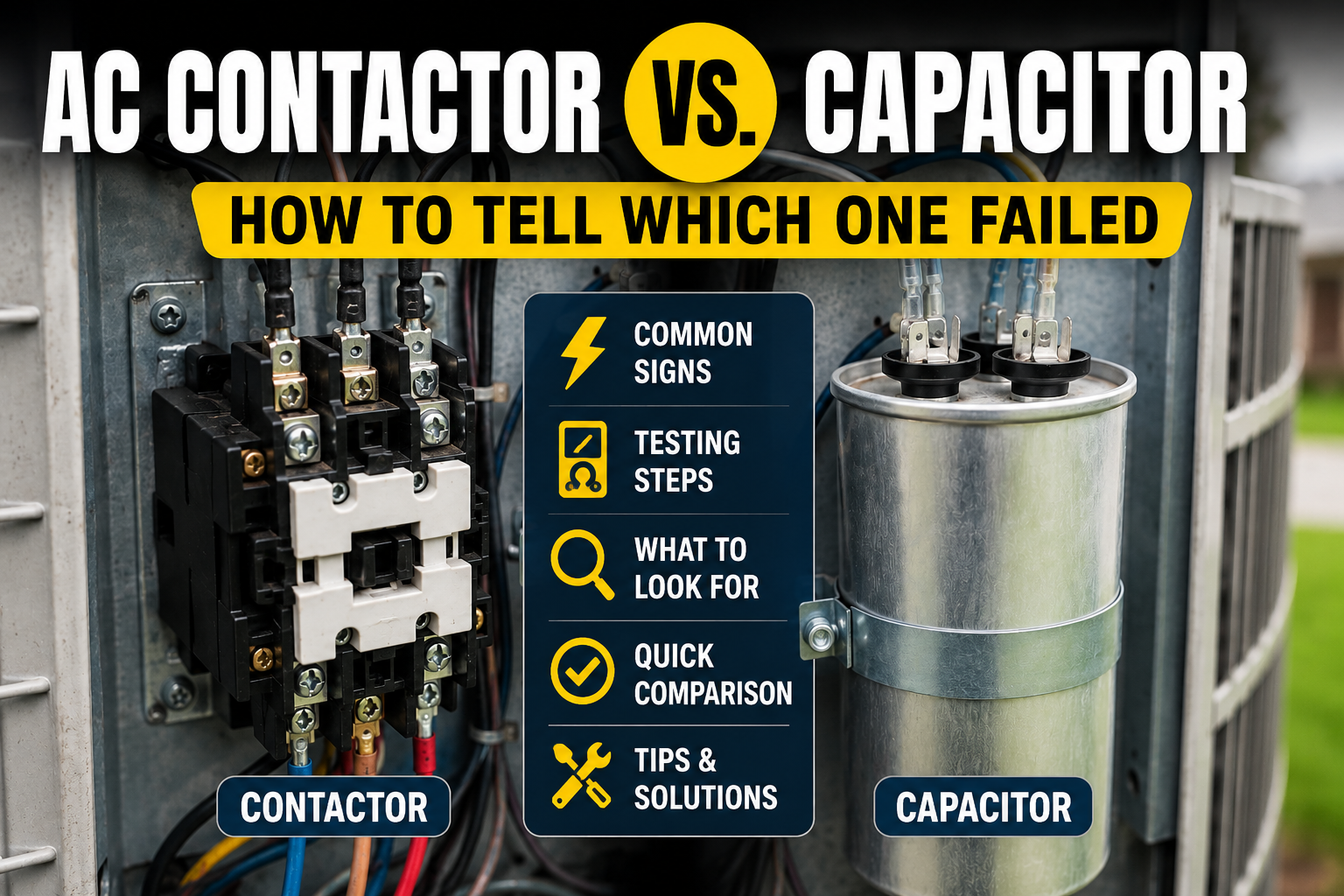
- The capacitor is a cylindrical or oval canister that stores and releases a burst of electrical energy, giving the compressor and fan motor the torque they need to overcome inertia and start spinning.
- The contactor is an electrically controlled switch. When the thermostat calls for cooling, the contactor closes and completes the 240V circuit, sending power to the compressor and fan motor in the first place.
In short: the contactor decides whether power reaches the outdoor unit. The capacitor decides whether the motors have enough torque to actually start once that power arrives.
The Symptom Both Share
This is where the confusion comes from — both failures can leave the outdoor unit doing nothing when the thermostat calls for cooling. But the details usually give it away.
Signs It's the Capacitor
- A steady humming sound from the outdoor unit, with the fan not spinning
- The system takes noticeably longer than usual to start
- Warm air from the vents while the indoor fan still runs normally
- Visible bulging, swelling, or oily residue on the capacitor itself
- The breaker trips repeatedly as the motor struggles to draw enough current to start
Signs It's the Contactor
- Complete silence from the outdoor unit — no hum, no attempt to start at all
- A distinct clicking sound when the thermostat calls for cooling, but nothing follows it
- The compressor won't shut off at all, even after the thermostat is satisfied (a contactor stuck closed)
- Visible pitting, charring, or carbon buildup on the contact points
- In humid climates, physical debris or insects bridging the contacts
The simplest rule of thumb: a hum usually points to the capacitor; silence or a click with no follow-through usually points to the contactor. Both parts can also fail in ways that mimic each other, which is why a multimeter test is the only way to confirm it before ordering.
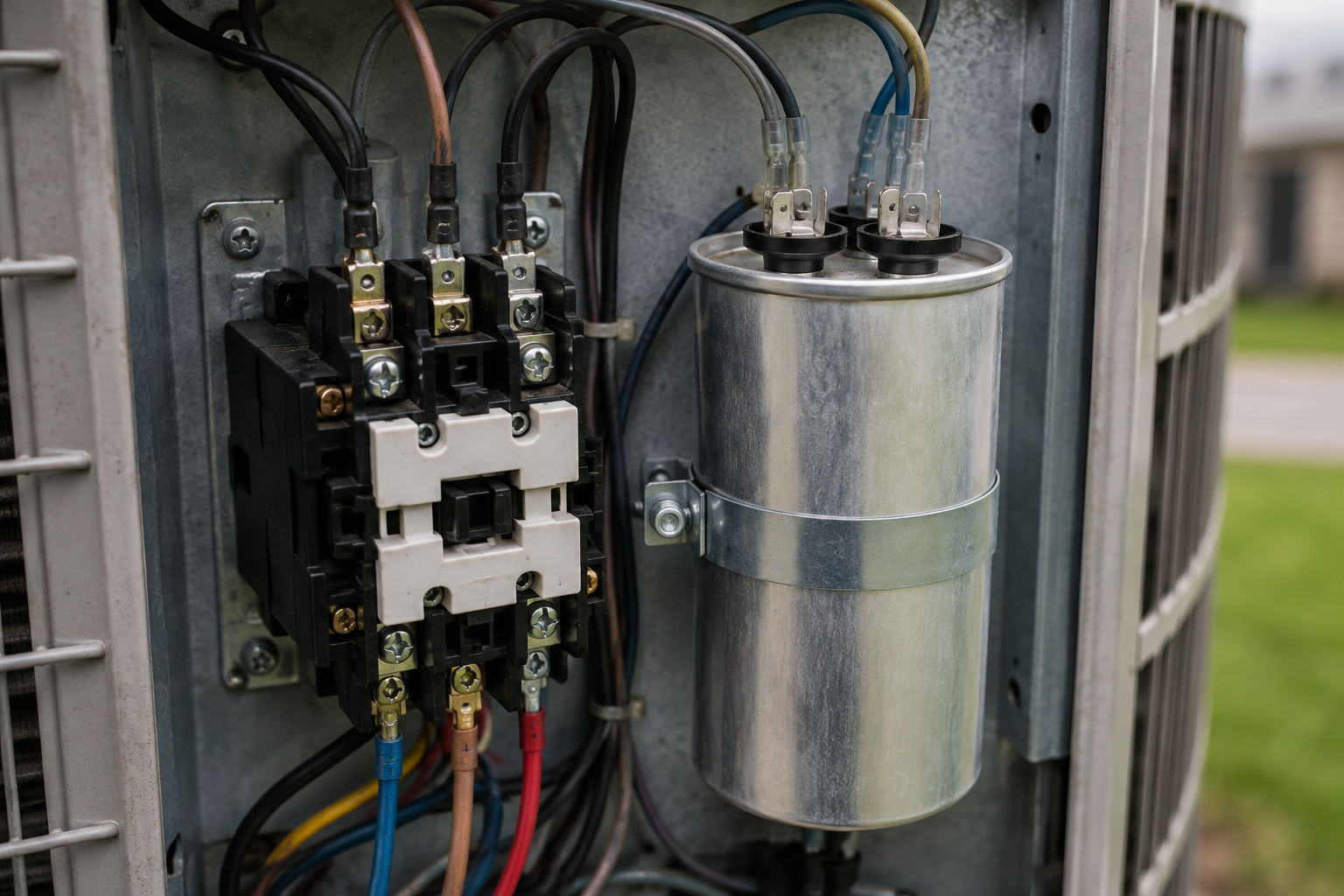
Side-by-Side Comparison
| Feature | Capacitor | Contactor |
|---|---|---|
| Job | Stores and releases energy to start the motor | Switches 240V power to the outdoor unit on and off |
| Typical Failure Symptom | Humming, hard starting, warm air | Silence, clicking with no start, or won't shut off |
| Visual Failure Signs | Bulging top, oily leakage | Pitted, burned, or corroded contacts |
| Typical Lifespan | 5–20 years | 5–10 years |
| Relative Cost | Inexpensive | Inexpensive |
How to Confirm Which One Failed
A visual inspection is the fastest first step, and it alone can often confirm the diagnosis:
- Check the capacitor first. A bulging top or oily residue around the terminals is a clear, immediate confirmation — replace it.
- Check the contactor contacts. Smooth and silvery means healthy. Pitted, blackened, or welded shut means it has failed.
- Test with a multimeter. A capacitor's microfarad (µF) reading should match its rated value; a contactor should show continuity across the contacts when energized. This step requires the power fully disconnected and the capacitor safely discharged first.
Misdiagnosing these two parts is one of the most common causes of an unnecessary second service call — replacing a capacitor when the contactor was the actual failure (or vice versa) leaves the original problem in place.
Pro Tip for Contractors: Always rule out the contactor before condemning a capacitor that tests within range — a pitted or chattering contactor can starve the motor circuit just enough to mimic weak-capacitor symptoms, even when the capacitor itself is still good.
Ordering the Right Replacement
Once you have confirmed which part failed, match specs exactly:
- For a capacitor, match the microfarad (µF) rating and voltage rating exactly — on dual run capacitors, there are two separate ratings printed on the label.
- For a contactor, match the coil voltage, pole configuration (single or double), and amperage rating to the original.
For a deeper walkthrough of capacitor types and how to choose a replacement, see our AC Capacitor Symptoms guide. For a closer look at how technicians isolate electrical faults safely across both components, our HVAC Electrical Diagnostics guide covers the full testing workflow.
A Note on Safety
Both parts sit inside a 240V circuit, and capacitors hold a stored charge even after power is disconnected. Confirming which part failed is safe to do visually from outside the panel; testing and replacement should only be done with the power fully off at the breaker, using insulated tools. If you are not confident working with high-voltage components, this is a job for a licensed HVAC technician.
Frequently Asked Questions
Can a bad contactor damage a good capacitor, or vice versa?
Yes. A pitted or arcing contactor can cause voltage irregularities that shorten a capacitor's life, and a weak capacitor forces the motor to draw excess current, which accelerates wear on the contactor's contacts. This is why technicians typically inspect both parts together, even when only one appears to have failed.
Why does my AC click but not turn on?
A click with no follow-through usually means the contactor is engaging (that's the click) but the motor still isn't starting — which points toward a capacitor issue, a seized motor, or a contactor that is closing but not making full contact. A multimeter test is the only reliable way to confirm which.
How long do contactors typically last?
Most residential contactors last 5–10 years, though hot and humid climates shorten that window due to increased arcing and, in some regions, insect intrusion into the contacts.
Is it cheaper to replace both at once?
Both parts are inexpensive individually, and since they sit in the same circuit and wear on similar timelines, many technicians replace both proactively during a service call rather than risk a second visit for the other part shortly after.
Final Thoughts
A humming outdoor unit points toward the capacitor. Silence or an unanswered click points toward the contactor. Confirming it with a quick visual check — or a multimeter for certainty — saves an unnecessary second trip and gets the right part ordered the first time.
Texpert Deals stocks both capacitors and contactors across all major voltage and amperage configurations, ready to ship same-day.
Related Reading: