Why a New Filter Drier Belongs in Every Sealed System Repair
There is a repair that looks successful on the day and fails eighteen months later: a sealed system opened, a component replaced, the system evacuated and recharged, and the original filter drier left in place to save a few dollars and twenty minutes.
The job runs fine through the rest of the season. Then the metering device starts intermittently restricting, or the compressor windings fail, and the callback arrives long enough after the repair that the connection is easy to miss. The drier is the part that was supposed to prevent exactly that.
What the Drier Is Actually Doing
A filter drier does three jobs at once, and only one of them is obvious from the name:
- Adsorbs moisture. A desiccant core — typically molecular sieve, often blended with activated alumina — chemically holds water out of circulation.
- Filters particulate. Brazing scale, metal shavings, and manufacturing debris get caught before they reach the metering device or compressor.
- Scavenges acid. The activated alumina component captures the acids that form when moisture, refrigerant, and heat meet.
That third function is why the part matters so much more than its price suggests.
Why Moisture Is the Real Enemy
Water in a sealed system does not sit there inertly. Under heat and pressure, moisture reacts with refrigerant through hydrolysis to form acids, and those acids attack what the system cannot afford to lose: compressor winding insulation and the copper surfaces throughout the circuit. The result is a slow, invisible degradation that eventually shows up as a shorted compressor.
Moisture has a second, faster failure mode. Free water circulating with the refrigerant can freeze at the metering device — a TXV port or a fixed orifice — and block flow intermittently. That produces one of the more maddening complaints in the trade: a system that cools correctly for a while, stops, and then recovers on its own once the ice melts, with no fault code and nothing wrong at the moment the technician arrives.
POE Oil Changes the Math
This is the part that makes modern systems less forgiving than older ones. R-410A and the A2L refrigerants replacing it use polyol ester (POE) oil rather than the mineral oil that ran with R-22. POE is strongly hygroscopic — it pulls moisture out of the air aggressively and then holds onto it.
Two practical consequences:
- Exposure time matters. An open system, or an open container of POE oil, absorbs atmospheric moisture far faster than mineral oil ever did.
- Evacuation alone does not fully fix it. Moisture bound into POE oil is much harder to pull out under vacuum than free moisture in the vapor space. A deep vacuum is necessary but is not, by itself, sufficient — which is precisely the gap a fresh drier is there to cover.
Pulling a proper deep vacuum remains essential, and anything that speeds that up — core removal tools, large-bore hoses, an adequately sized pump — is worth the setup time. But the drier is what handles what the vacuum leaves behind.
Why the Old One Cannot Be Reused
A desiccant core is a consumable with a finite capacity, and it has been working since the day the system was commissioned. By the time a technician opens the system, some unknown fraction of that capacity is already spent.
Worse, the moment the circuit is open to atmosphere, the core begins adsorbing ambient humidity. On a humid day an exposed drier can take on a meaningful load of moisture while the technician is still working. Reinstalling it means installing a component that is partially — sometimes largely — saturated before the system is even closed.
There is no field method to regenerate a saturated core. It is a single-use part, and it should be treated the way a gasket or an O-ring is treated: replaced whenever the assembly is opened, not inspected and reused.
Choosing the Right Drier
| Situation | What to Install |
|---|---|
| Routine sealed system repair, AC only | Liquid line drier, sized to system capacity |
| Any heat pump | Bi-flow drier — standard driers are directional |
| After a compressor burnout | Liquid line drier plus a suction line drier with an acid-scavenging core |
| Compressor replacement | New liquid line drier as standard practice |
| Repeated moisture-related failures | Oversized drier, plus investigate the leak letting air in |
The Bi-Flow Requirement
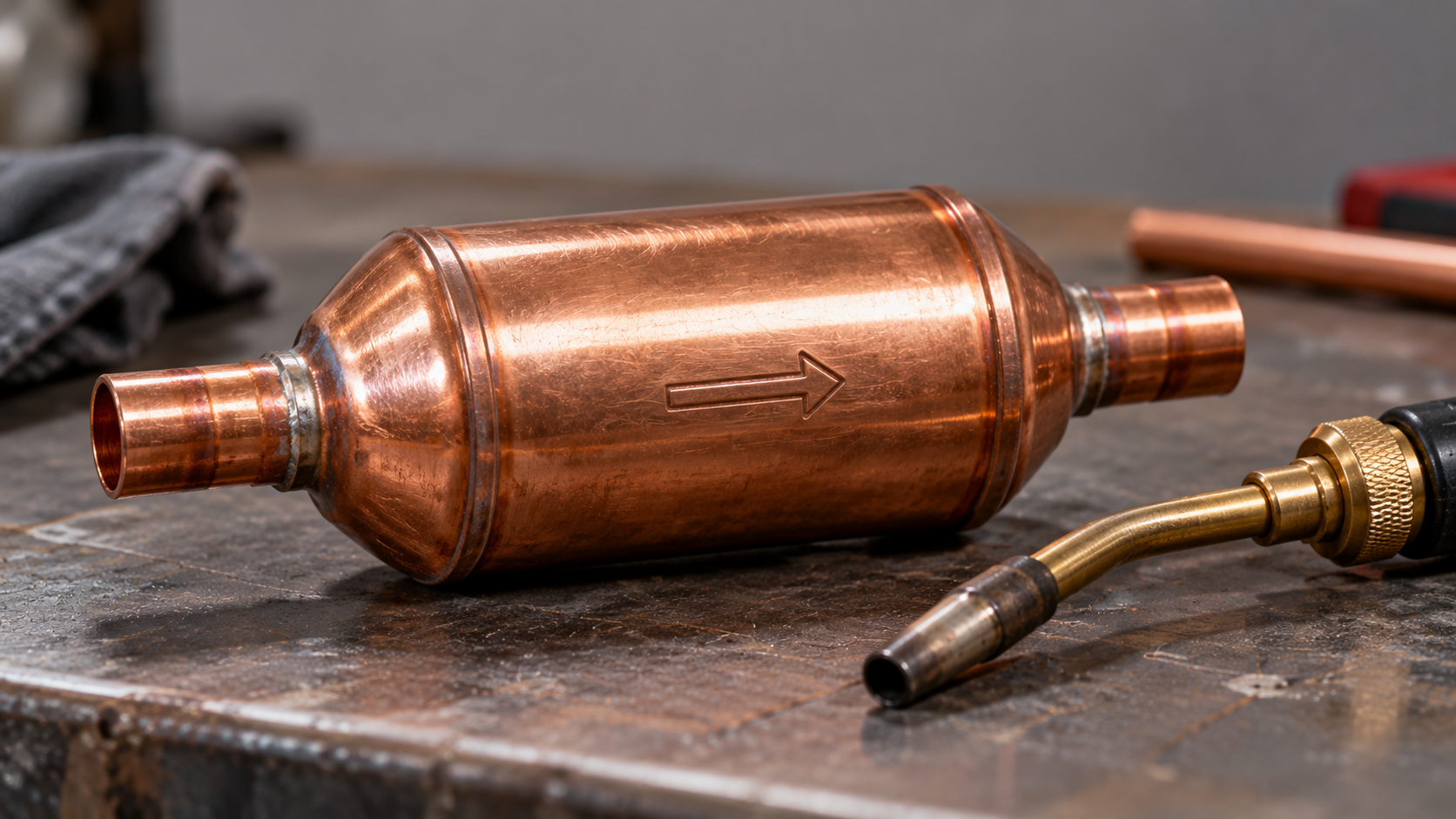
This one gets missed often enough to be worth isolating. A standard liquid line drier is built to flow in one direction — there is an arrow stamped on the body, and the internal construction depends on it.
A heat pump reverses refrigerant flow every time it switches between heating and cooling, and during defrost. Installing a standard directional drier on a heat pump means that for half of the system's operating life the flow is running backward through it, which can push accumulated debris back out of the filter and into the circuit it was protecting.
Heat pumps need a bi-flow drier, designed with internal check valves or a symmetrical construction so it filters correctly in both directions.
Sizing and Installation
Match these before ordering:
- System capacity in tons — undersized driers restrict flow and saturate quickly.
- Connection size and type — sweat (ODF) versus flare (SAE), and the line diameter.
- Flow direction, or bi-flow for heat pumps.
- Core type — standard moisture and particulate, or acid-scavenging for burnout cleanup.
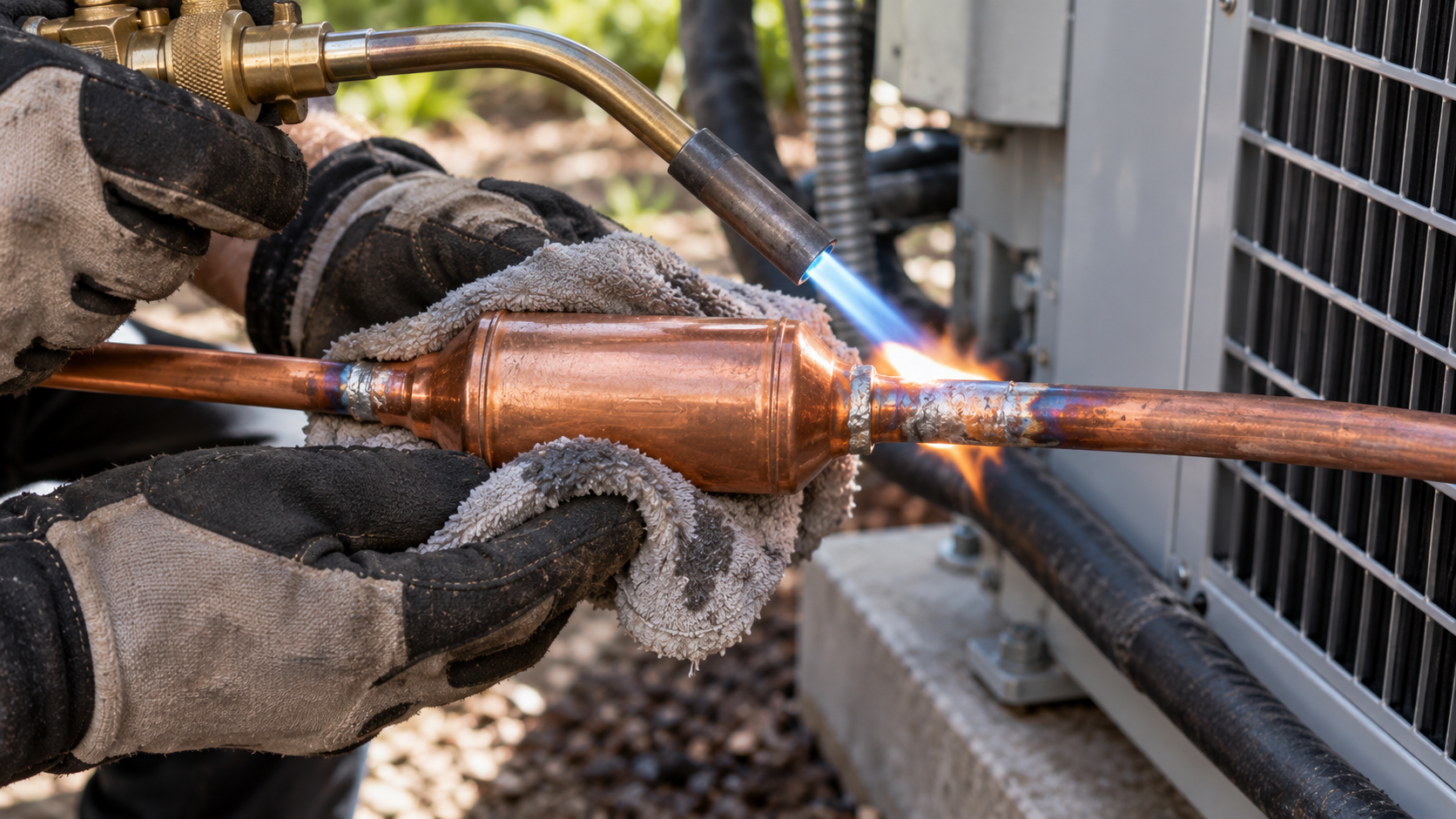
At installation, protect the core from brazing heat. A wet rag or heat sink compound around the drier body keeps the desiccant from being cooked during the braze — an overheated core loses capacity before the system is even running. And verify the flow arrow against actual flow direction before the torch comes out, because correcting it afterward means cutting the part back out.
Pro Tip for Contractors: Feel across the drier once the system has been running. A noticeable temperature drop from inlet to outlet — or visible sweating on the outlet — means significant pressure drop through a restricted core. On a system that was just repaired, that is usually a sign the core is already loaded with debris the repair introduced, and it needs replacing again rather than monitoring.
The Attach-Rate Argument
For contractors pricing work, the drier is one of the easiest line items to justify to a customer and one of the most expensive to omit. It is a low-cost part sitting directly upstream of the two most expensive components in the system.
Stocking them on the truck in the common capacities and connection types is what makes replacing them routine rather than a decision made at the end of a long job. The repair that skips the drier is almost never a deliberate engineering choice — it is a part nobody had on hand.
Texpert Deals stocks filter driers in liquid line and bi-flow configurations, along with the access valves and fittings, vacuum pumps, and refrigerants and charging kits that make up the rest of a sealed system repair.
Frequently Asked Questions
Do I really need a new drier for a small repair?
If the sealed system was opened to atmosphere, yes. The exposure is what spends the core, and a brief opening on a humid day is enough to load it meaningfully. If the system was never opened, the existing drier is undisturbed.
Can a filter drier be installed backward?
On a standard directional drier, installing it against the flow arrow defeats the filtration and can release trapped debris downstream. On a bi-flow drier, direction does not matter — which is part of why they are the correct choice for heat pumps.
How do I know if a drier is restricted?
A temperature drop across the body during operation, or frost and condensation on the outlet side, indicates meaningful pressure drop through the core. A significantly restricted drier starves the metering device and shows up as poor cooling with abnormal pressures.
Is a suction line drier always needed after a burnout?
It is standard practice for acid cleanup, using a core specifically rated for acid scavenging. Because it sits in the suction line it adds pressure drop, so it should be checked after a period of operation and removed or replaced according to the manufacturer's guidance rather than left indefinitely.
Does the A2L transition change any of this?
The moisture chemistry and the role of the drier are unchanged, and POE oil remains hygroscopic. What changes is the handling — flammability classification, equipment compatibility, and fitting requirements — so verify that any drier is rated for the refrigerant in the system.
Final Thoughts
Treat the drier as part of the repair, not an optional extra. If the system was open, the core is spent — install a new one, match the capacity and connections, use bi-flow on every heat pump, and keep the brazing heat off the body. It is the cheapest insurance available against the two failures that cost the most to fix.
Browse filter driers and refrigeration components, or request a wholesale quote for truck-stock quantities.