No C-Wire for Your Thermostat? Here Are Your Four Real Options
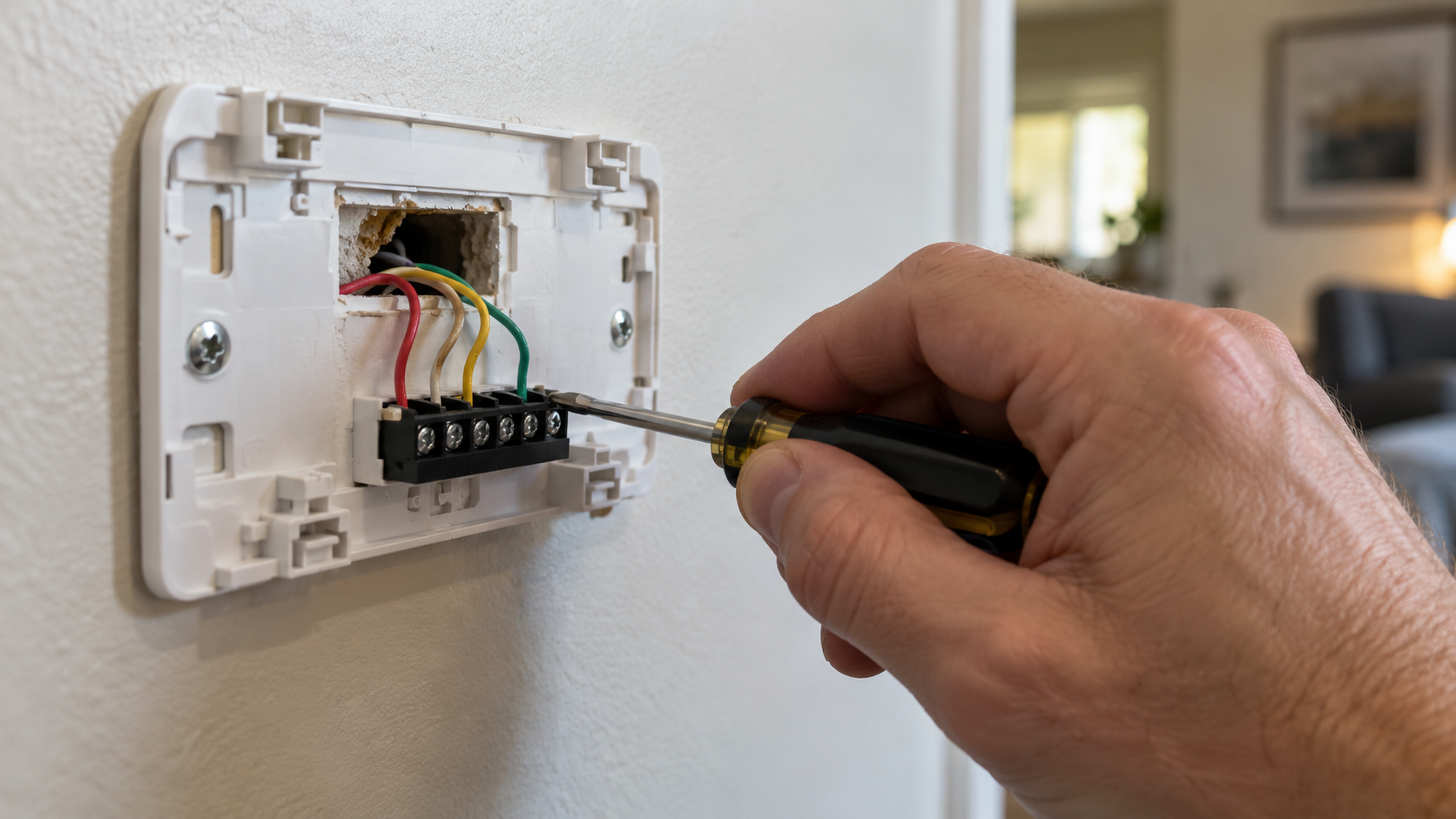
Smart thermostat installs stall on the same obstacle more than any other: the wall has four wires, and none of them is a common. The thermostat powers up on battery, seems to work, and then starts behaving strangely a few weeks later — or refuses to run the system at all.
There are four legitimate ways to solve this, and they are not equally good. Here is what each one actually involves, in the order most technicians should try them.
What the C-Wire Does
A low-voltage control circuit needs a complete loop. The R terminal supplies 24V from the transformer, and each call wire — W for heat, Y for cooling, G for the fan — closes a circuit when the thermostat asks for that function.
The problem is that those circuits are only closed while the system is running. An old mercury or bimetal thermostat did not care; it needed no power of its own. A modern thermostat with a display, Wi-Fi radio, and a processor needs continuous power whether the system is heating, cooling, or idle.
The C terminal — common — provides the return path to the transformer that stays connected at all times. That is the entire purpose of the wire. Without it, a thermostat has to get its power some other way, and every workaround is a variation on that problem.
Houses wired before smart thermostats were common often ran only four conductors, because four was all anyone needed.
Option 1: Find a Spare Conductor
Check this first, every time. Thermostat cable is commonly sold in 5-conductor and 8-conductor bundles, and installers frequently pulled more conductors than the original thermostat used, then tucked the extras into the wall cavity.
Pull the thermostat off the wall and gently draw the cable out. An unused conductor — often blue — tucked behind the plate is the cleanest possible outcome: land it on C at the thermostat, land the matching end on C at the air handler board, and the job is done with no compromises.
Check the air handler end as well. The spare is sometimes capped there instead.
Option 2: Repurpose the G Wire
If there is no spare and the bundle has exactly four conductors, the fan wire can sometimes be reassigned to common. The trade-off is real and worth stating plainly: you lose independent fan control, so "fan on" as a standalone function stops working.
On a system where the fan always runs with a heating or cooling call and the occupants never use fan-only circulation, this is an acceptable compromise. On a system with a variable-speed blower used for continuous circulation, air filtration, or a whole-house ventilation strategy, it is not — and it will generate a callback from a client who notices the feature is gone.
This option also requires rewiring both ends consistently. Doing it at the thermostat alone accomplishes nothing.
Option 3: Install a Wiring Adapter
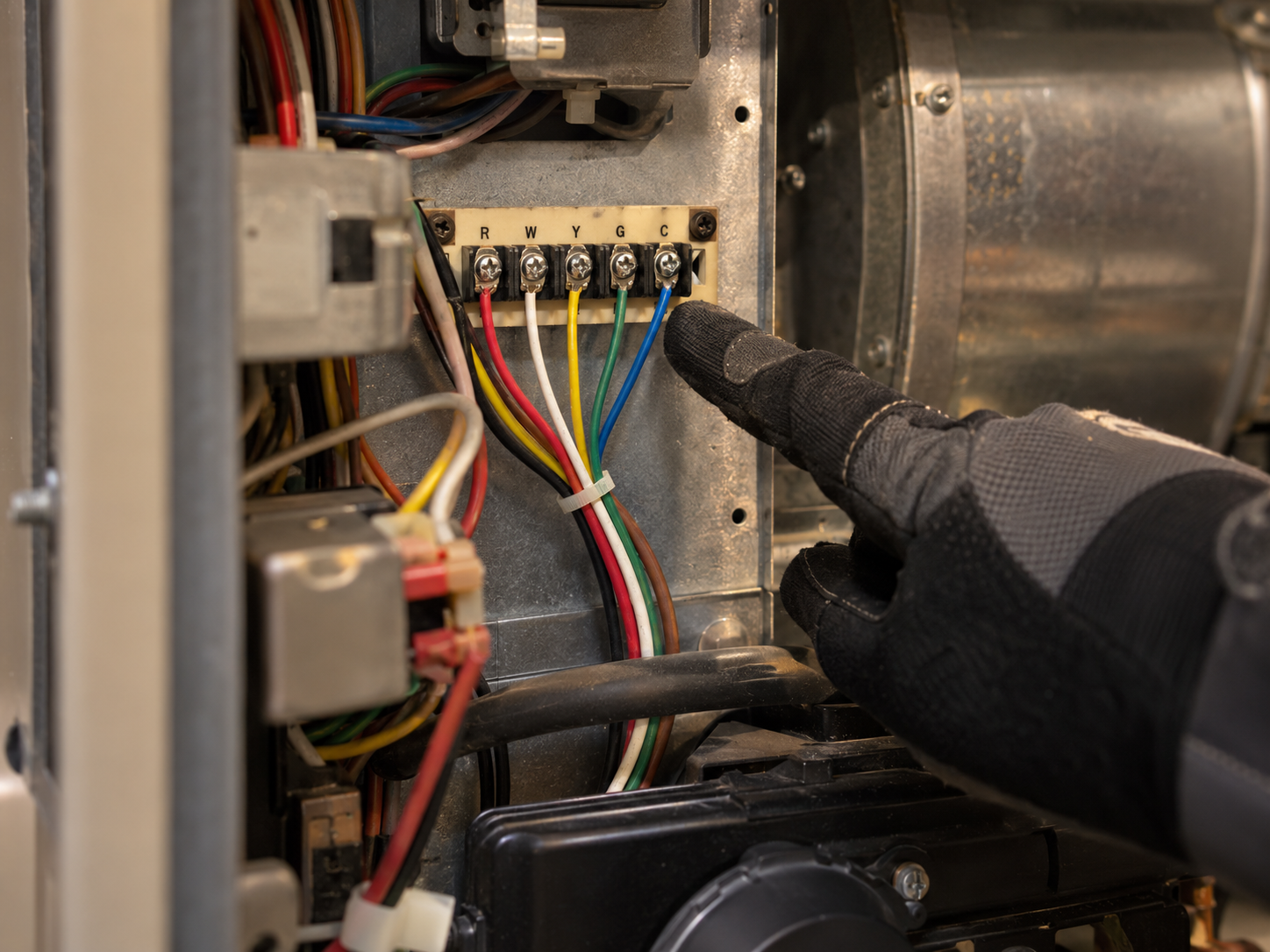
An add-a-wire adapter is a small module installed at the air handler that multiplexes signals so four existing conductors carry what would normally require five. Some thermostat manufacturers ship their own version in the box; universal adapters cover the rest.
This is the best option when there is no spare conductor and the client needs full fan control retained. It keeps the existing wiring in the wall, which matters when the alternative is fishing new cable through finished walls or a tight chase.
Two things to verify before committing: that the adapter is compatible with the specific thermostat, and that it is compatible with the system type. Multi-stage, heat pump, and communicating systems have more signals to carry, and not every adapter supports every configuration.
Option 4: Add an External 24V Transformer
A plug-in 24V transformer at the thermostat supplies the continuous power the C-wire would have provided. It works reliably, and the parts cost very little.
The reason it ranks last is presentation. It means a visible cord running from the thermostat to an outlet, which is acceptable in a utility space or a rental and usually unacceptable in a living room. There also has to be an outlet near the thermostat, which is often not the case.
Where it genuinely shines is commercial and multi-unit work — mechanical rooms, back-of-house spaces, and anywhere appearance is not a consideration and running new cable across a commercial ceiling would be expensive.
The Fifth Path: A Thermostat That Does Not Need One
Some thermostats are designed to run without a C-wire, using a technique called power stealing — drawing a trickle of current through the heating or cooling circuit to charge an internal reservoir without closing the circuit enough to activate the system.
It works, and on many systems it works indefinitely. But it is worth understanding the failure mode before recommending it as the default, because when it goes wrong the symptoms are confusing: relay chatter, the system briefly cycling on by itself, a thermostat that drops its Wi-Fi connection when the system has been idle a long time, or intermittent faults on control boards whose electronic sensing circuits are sensitive to that small parasitic draw.
For a simple single-stage system, power stealing is often fine. On a newer high-efficiency furnace with a sophisticated control board, running a proper common is the more durable choice — and considerably easier than returning to diagnose ghost cycling six months later.
Comparing the Options
| Approach | Best For | Main Drawback |
|---|---|---|
| Spare conductor | Any install where one exists | None — always check first |
| Repurpose G | 4-wire systems with no fan-only need | Loses independent fan control |
| Wiring adapter | 4-wire systems needing full function | Compatibility must be verified per system |
| External transformer | Commercial, utility, and back-of-house spaces | Visible cord; needs a nearby outlet |
| Power-stealing thermostat | Simple single-stage systems | Possible chatter or ghost cycling on sensitive boards |
Pro Tip for Contractors: Before adding an external transformer, check the existing transformer's VA rating against the connected load. A system already near capacity with a damper motor, humidifier, and zone panel on it can brown out when a new device is added — and an undersized transformer produces intermittent faults that look like a failing control board.
A Note on Heat Pumps
Heat pump systems need more conductors than conventional systems — a reversing valve signal (O/B) and often auxiliary and emergency heat stages on top of the usual terminals. That means less room to repurpose a wire and a higher chance that an adapter will not support the configuration.
On a heat pump with a four-conductor run, pulling new cable is frequently the honest recommendation rather than stacking workarounds on a circuit that has no spare capacity to give.
Frequently Asked Questions
Can I just leave the thermostat on batteries?
Battery-only operation works on thermostats designed for it, but Wi-Fi radios drain batteries quickly. On a smart thermostat the practical result is frequent battery replacement and a device that goes offline at inconvenient times. For a connected thermostat, continuous power is the right answer.
What color is the C-wire?
Blue is the most common convention, with black also used. But color conventions are not guaranteed — plenty of installations use whatever was in the bundle. Always verify by terminal, not by color.
Will a C-wire fix my thermostat losing Wi-Fi?
Often, yes. A thermostat dropping its connection during long idle periods is a classic symptom of insufficient power, because the radio is the first thing to go when the internal reservoir runs low. Confirm there is not also a signal strength problem before assuming power is the whole story.
Do all smart thermostats require a C-wire?
No. Several are specifically designed to work without one. Whether that is the right choice depends on the system — see the power-stealing section above for when it holds up and when it does not.
Is this a safe DIY job?
Thermostat wiring is low-voltage, which makes it one of the more approachable HVAC tasks, and the power should still be shut off at the breaker before starting. The part that goes wrong for non-professionals is not the wiring itself but the diagnosis — misreading which terminal does what, or mis-landing a wire at the air handler, can damage a control board. If the wiring is not clearly labeled, it is worth bringing in a technician.
Final Thoughts
Check for a spare conductor before anything else; it solves the problem outright more often than most people expect. Past that, the choice comes down to what the client needs and where the thermostat lives: an adapter where full function matters, a repurposed G where fan-only control genuinely is not used, an external transformer where appearance is not a factor, and a power-stealing thermostat on simple systems where its limits will not be reached.
Browse thermostats, thermostat wiring adapters, and 24V transformers, or request a wholesale quote for volume orders.