Furnace Leaking Water? Understanding the Condensate System
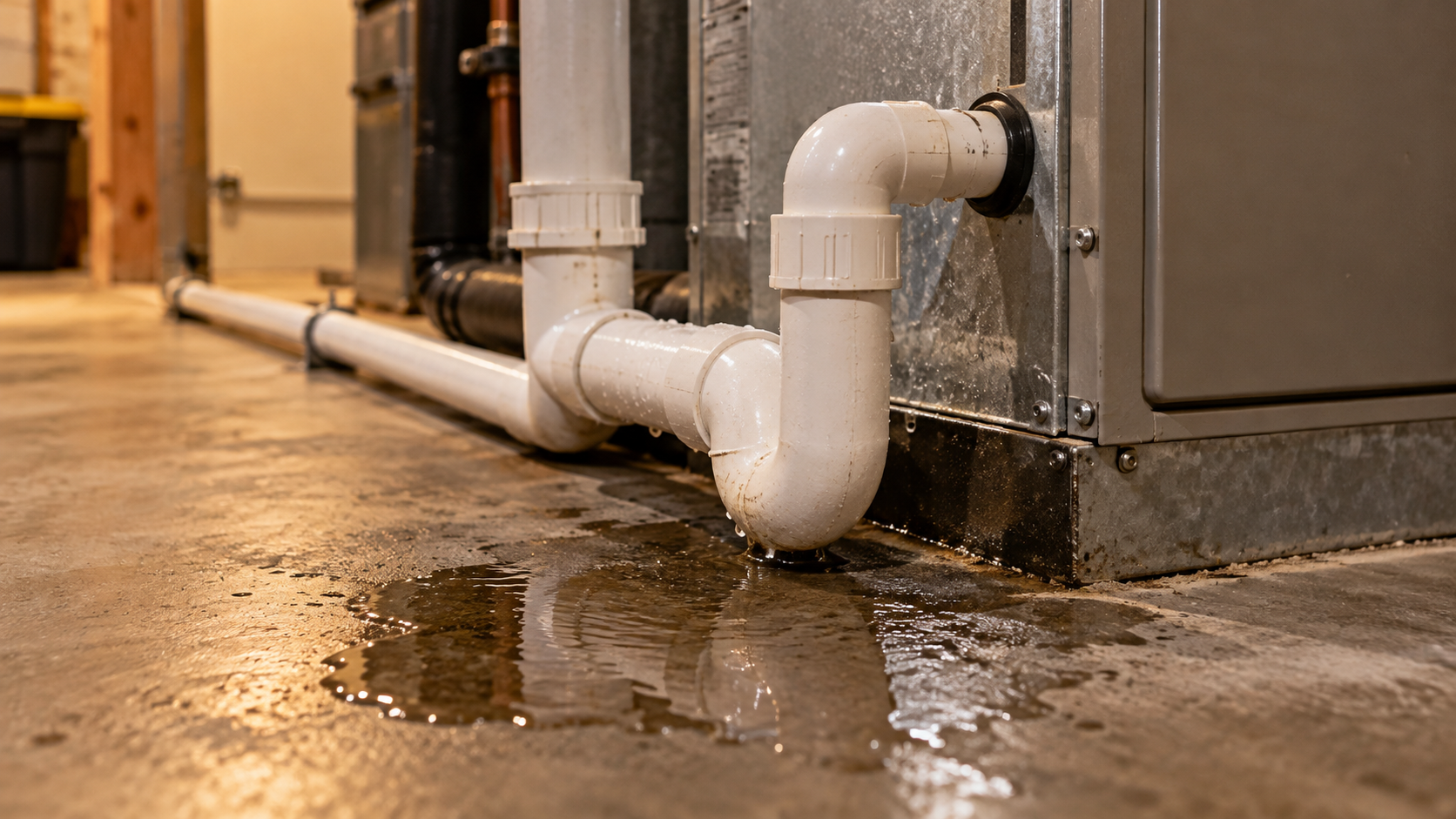
A puddle under the furnace in January surprises a lot of homeowners, because nothing about heating season suggests the equipment should be producing water. But a high-efficiency condensing furnace can generate several gallons a day while it is running hard, and every drop of it has to get out of the cabinet and into a drain.
When that path is blocked, the visible leak is usually the least of the problems. The same blockage is what trips pressure switch faults, drives nuisance lockouts, and quietly corrodes whatever the water lands on.
Why a Furnace Makes Water at All
An 80% furnace sends its exhaust up a metal flue while it is still hot, which is where a good share of the energy goes. A condensing furnace — anything in the 90%+ AFUE range — adds a secondary heat exchanger that pulls additional heat out of those flue gases before venting them.
Extracting that heat cools the exhaust past its dew point, and the water vapor in it condenses into liquid. That is where the efficiency gain comes from, and the condensate is simply the by-product. It is also why these furnaces vent through PVC rather than metal: the exhaust leaves cool enough that plastic handles it, and metal would corrode.
The condensate itself is mildly acidic, typically in the pH 3–5 range, because it carries dissolved combustion by-products. That matters for two reasons: it is hard on certain drain materials over time, and it feeds the biological growth that eventually clogs the line.
Where the Water Is Supposed to Go
The path is short but has several places to fail:
- Condensate collects in the secondary heat exchanger and inducer housing, which both have drain ports
- It flows into a collector box and trap, which blocks flue gases from following the water out
- From there into a drain line, pitched downhill
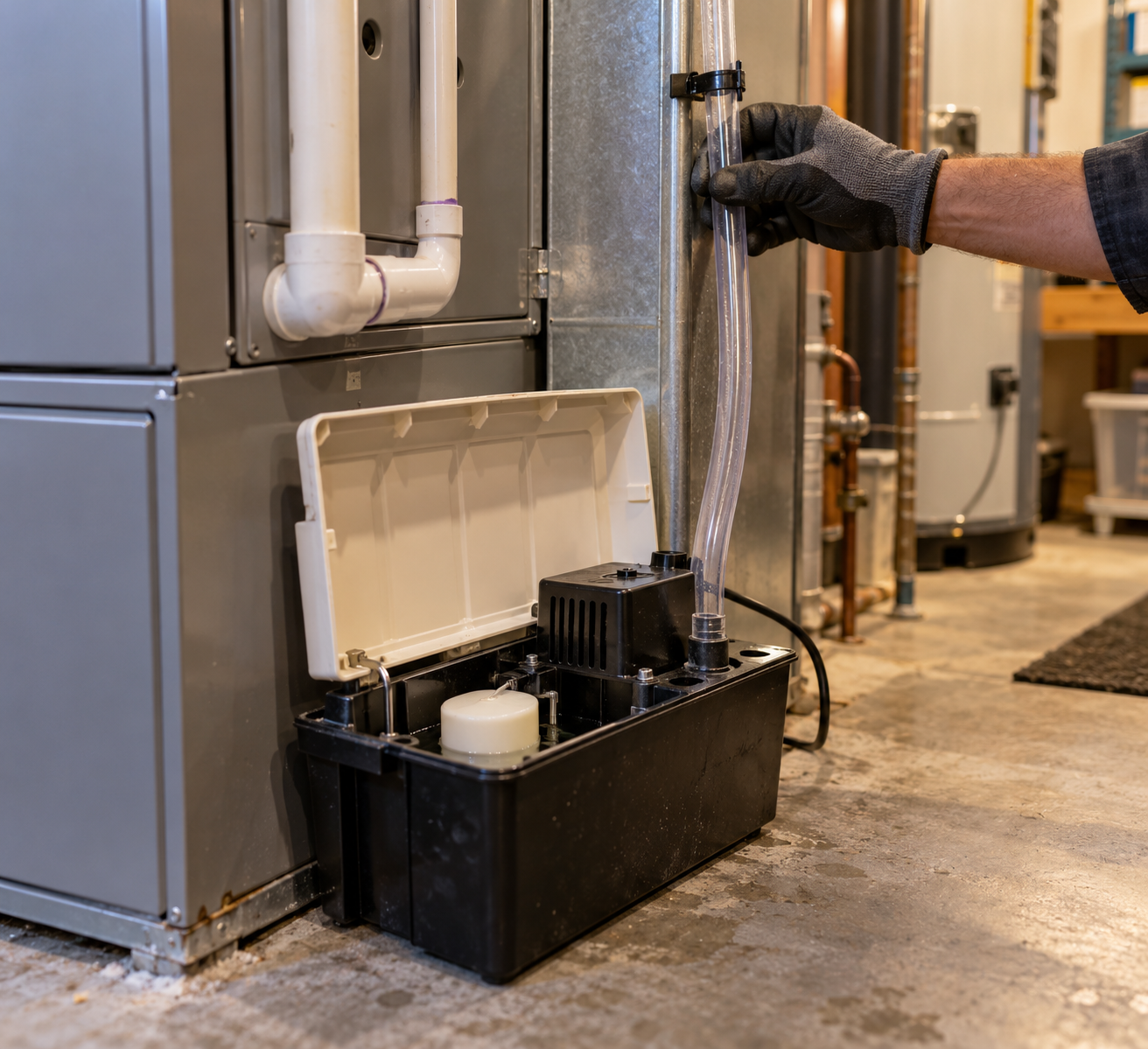
- And finally to a floor drain, standpipe, or condensate pump if gravity cannot do the job
In cooling season the evaporator coil's drain pan often ties into the same line, which means a clog can show up as an air conditioning problem in summer and a furnace problem in winter.
What Actually Blocks It
- Biofilm and sludge in the trap. The most common cause by a wide margin. Standing condensate grows a slimy residue that thickens over seasons until the trap stops passing water.
- A frozen drain line. Any run through an unconditioned space — a crawlspace, an attic, a garage, or an exterior wall — can freeze solid during a cold snap. This is why these calls cluster around the first hard freeze.
- A dry or unprimed trap. A trap that has been emptied during service and not refilled lets flue gases push through the drain instead of water flowing out.
- Improper pitch. A line that sags or runs level pools water, which then grows the sludge that blocks it. A clean line installed flat will clog again.
- A failed condensate pump. Either the motor, the float switch, or a clogged discharge tube. The reservoir fills and overflows.
- A plugged inducer housing drain port. Small, easy to overlook, and it backs water up directly into the housing the pressure switch monitors.
- A cracked collector box or heat exchanger. Less common and considerably more serious — this needs a technician, not a drain cleaning.
Reading the Symptom
A condensate problem rarely announces itself as "the drain is clogged." It shows up as something else first:
| What You Observe | Likely Cause |
|---|---|
| Water pooling under or beside the furnace | Blocked trap or drain line, or a failed pump |
| Inducer runs, no ignition, pressure switch fault | Condensate backed up into the inducer housing |
| System shuts down with no visible water | Condensate safety switch tripped on a full pan or reservoir |
| Gurgling from the drain during operation | Partial restriction, or a trap pulling air |
| Pump runs constantly without emptying | Clogged or kinked discharge tube, or a failed check valve |
| Combustion smell near the drain | Dry or unprimed trap letting flue gases through |
The second row is worth dwelling on, because it is the single most common pressure switch fault in the field. The board reports a pressure switch problem, the switch is fine, and the actual fault is a few inches of water sitting where air should be moving.
The Condensate Safety Switch
A condensate safety switch — often called a float switch — sits in the drain pan or inline on the drain, and shuts the system down when water rises past a set level.
It is doing the same job the pressure switch does for draft: forcing a shutdown before a small problem becomes an expensive one. A system that quits with no obvious cause, and no water anywhere visible, has frequently tripped one of these — the switch caught the backup before anything overflowed.
On any installation above a finished ceiling or living space, these are not optional in practical terms. The cost of the switch is trivial against the cost of a ceiling.
Pro Tip for Contractors: After clearing a trap, always re-prime it with clean water before closing up. A dry trap passes the leak test and then lets flue gases into the drain line, which produces a combustion odor near the furnace that gets misdiagnosed as a heat exchanger crack — an alarming and expensive wrong turn.
Keeping It From Recurring
Clearing a clog is the easy part. Preventing the next one is what keeps a client from calling back:
- Verify the pitch along the full run. Any sag will pool water and regrow the clog regardless of how well the line was cleared.
- Insulate or reroute any run through unconditioned space before the next freeze rather than after it.
- Treat the line. Condensate pan treatments and tablets slow the biological growth that causes most clogs. For systems draining into cast iron or other sensitive materials, a pH neutralizer — limestone-media cartridges, or a treatment product such as those from Nu-Calgon — raises the condensate pH before it reaches the plumbing.
- Add a safety switch if there is not one, on any system where an overflow would cause damage.
- Service the pump rather than only the drain. Reservoirs accumulate the same sludge the lines do, and a check valve that no longer seats makes the pump cycle endlessly.
Sizing a Condensate Pump
When gravity drainage is not available, the pump has to be matched to the job rather than grabbed off the shelf:
- Lift height — the vertical distance from pump to discharge point, which is the spec most often underestimated.
- Flow capacity against that lift, since rated gallons per hour drops as lift increases.
- Reservoir volume, which determines cycling frequency.
- A built-in safety switch to shut the system down if the pump fails, rather than letting the reservoir overflow.
- Material compatibility with acidic condensate — relevant where the pump handles furnace condensate rather than only AC condensate.
Texpert Deals stocks condensate pumps, condensate safety switches, and drain pans, alongside the pressure switches that so often get replaced for what is really a drainage problem.
Frequently Asked Questions
Is it normal for my furnace to drain water in winter?
For a high-efficiency condensing furnace, yes — producing condensate is how it achieves its efficiency rating. Water flowing steadily to a drain is normal. Water pooling on the floor is not.
How much water should a furnace produce?
It varies with furnace size and runtime, but several gallons across a cold day is unremarkable for a condensing furnace running long cycles. The volume is enough that the drain path genuinely matters.
Can I pour bleach down the condensate drain to clear it?
It is a common field practice, but bleach is corrosive to some metal components and can damage certain pump materials and plumbing. Purpose-made condensate pan treatments are formulated for the job and are the safer choice, particularly on systems with a pump in the path.
Why does my AC leak in summer and my furnace leak in winter?
Because they usually share a drain line. The evaporator coil pan ties into the same path as the furnace condensate, so one clog produces a seasonal symptom in both modes.
Does condensate damage plumbing?
It can, over time, where the drain discharges into cast iron or certain older materials — the acidity is mild but the exposure is continuous. PVC and ABS are unaffected. Where sensitive materials are in the path, a neutralizer in the line addresses it.
Is clearing a condensate drain a safe DIY job?
Clearing an accessible trap or drain line is reasonable homeowner maintenance with the power off. What is worth leaving to a technician is anything behind it — a drain that clogs repeatedly, a pressure switch fault that persists after clearing, or a combustion odor near the furnace all point to a cause the drain cleaning did not reach.
Final Thoughts
Water on the floor is the obvious symptom, but the condensate system is just as often behind faults that look electrical — pressure switch codes, unexplained shutdowns, short cycling. Clear the trap, verify the pitch across the whole run, protect anything passing through unconditioned space before the first freeze, and treat the line so the clog does not simply regrow.
Browse condensate pumps and drainage components, or request a wholesale quote for volume orders through heating season.