Ignitor Glows but No Flame? Check the Signal Before the Gas Valve
The sequence looks almost right, which is what makes this one frustrating. The inducer spins up, the pressure switch closes, the ignitor glows bright orange on schedule — and then nothing. No whoosh, no flame, no heat. The ignitor cools, the furnace tries twice more, and locks out.
Gas is clearly not arriving at the burners, so the gas valve takes the blame. It is also the most expensive component in the ignition path, and in a large share of these calls it is working perfectly. The thing that was missing was the signal telling it to open.
First: If You Smell Gas, Stop
If there is a gas odour in the space, this is not a diagnostic exercise. Leave the building, do not operate switches or electrical devices, and call the gas utility's emergency line or the fire department from outside. Everything below assumes no gas smell and no sign of a leak.
Three Things Have to Be True
For burners to light, all of these must hold:
- Gas is present at the valve inlet — supply is on and reaching the furnace
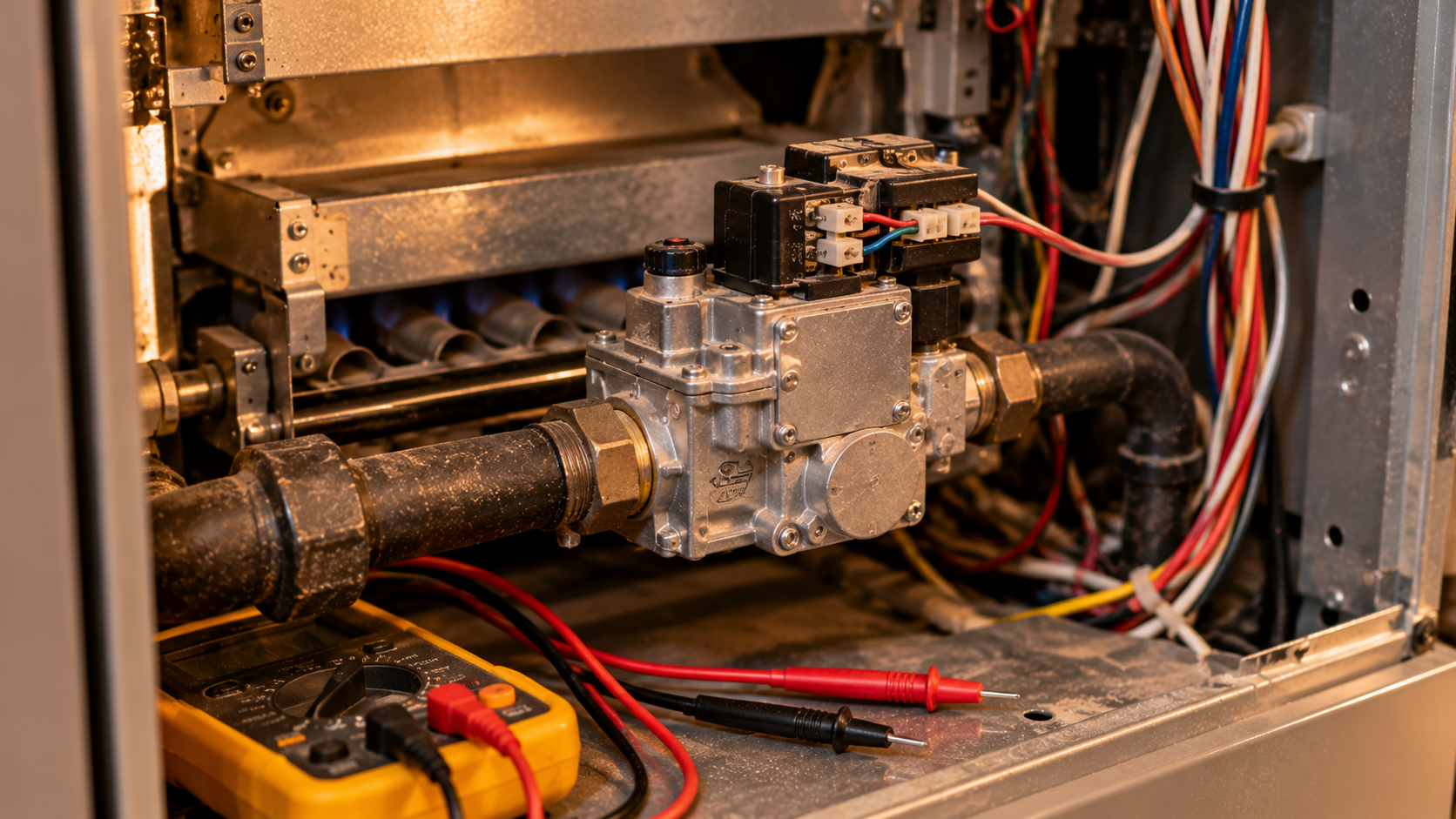
- The board is sending the valve its open signal — nominally 24V on the valve's control terminals
- The valve responds by opening and delivering gas to the manifold
The glowing ignitor already tells you something useful: the board got through the pressure switch and the safety circuit far enough to energize the ignitor. But the gas valve is a separate output, and on many systems it sits behind additional conditions. The ignitor glowing does not prove the valve was ever told to open.
The Order That Saves Money
1. Confirm gas is actually available
This sounds too obvious to check, and it is the answer often enough to be worth thirty seconds. Is the manual shutoff at the furnace in the open position? Do other gas appliances in the building work — a range, a water heater? Was there recent service work, a meter change, or utility work in the street? A valve handle left perpendicular after a previous repair produces exactly this symptom.
A furnace that has just been installed, relocated, or converted deserves extra scrutiny here, as does one in a building where the gas was shut off over summer.
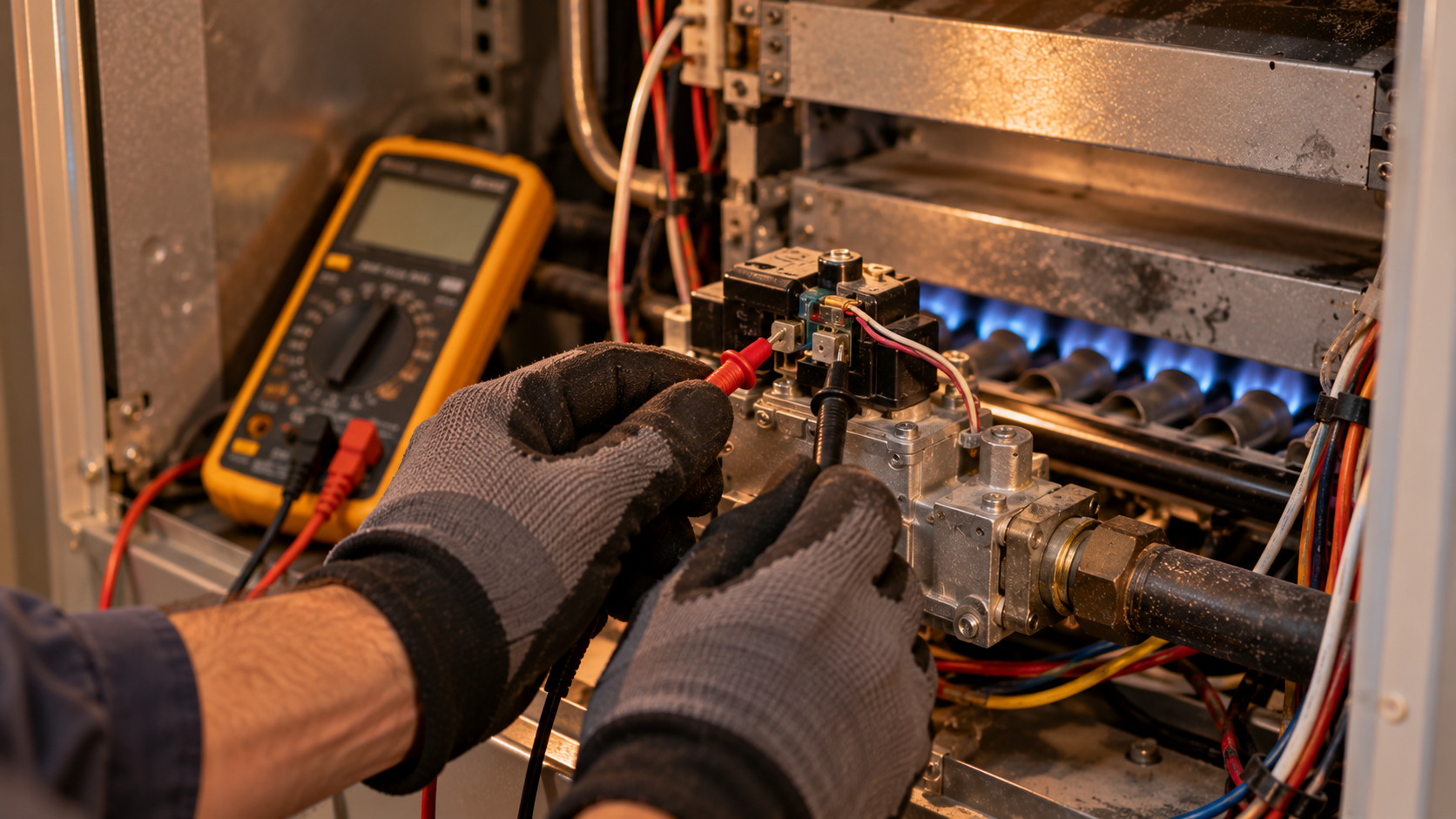
2. Check for the 24V signal at the valve
This is the measurement that decides everything, and it splits the diagnosis cleanly in two:
- No signal at the valve during the ignition attempt. The valve is not being told to open, so the valve is not the fault. The problem is upstream — the control board, a safety device in series that has opened, a connector, or the wiring itself.
- Signal present, gas available, and still no flame. Now the valve is a legitimate suspect.
Skipping this step is how an expensive part gets replaced to fix a problem it never had. A new valve installed on a furnace that is not energizing the valve behaves identically to the old one.
3. If there is no signal, work upstream
The usual causes, in rough order:
- An open safety in series. A rollout switch, limit switch, or auxiliary limit that has tripped will stop the sequence before the valve energizes. A rollout switch in particular needs investigating rather than resetting.
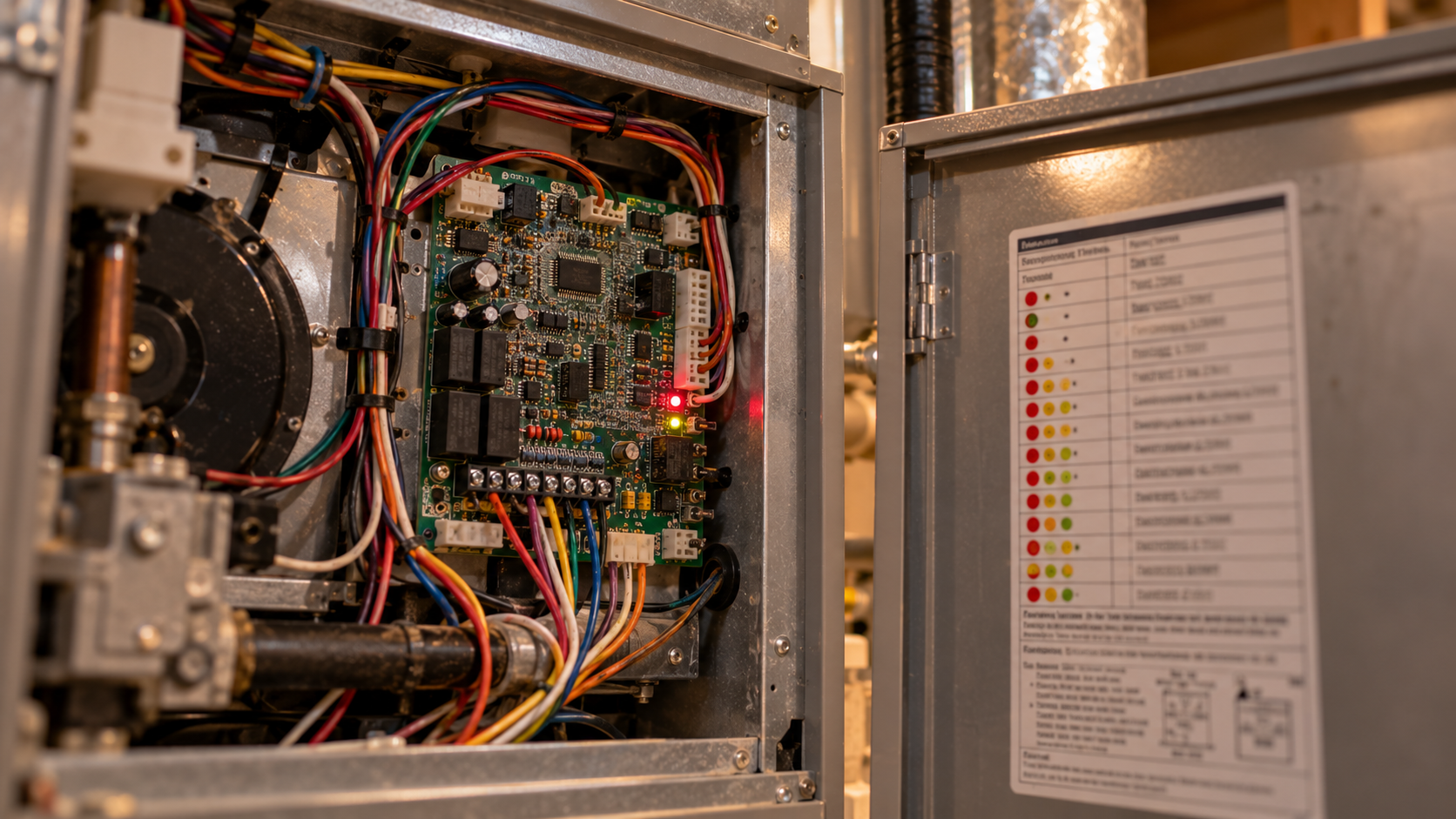
- A control board output failure. The board energized the ignitor and failed to energize the valve relay.
- Wiring and connectors. A corroded terminal, a backed-out pin, or a chafed wire between the board and the valve.
- Low control voltage. A weak transformer or an overloaded 24V circuit can produce enough voltage to run the ignitor circuit and not enough to reliably pull in the valve.
4. Rule out fuel type and staging mismatches
Two configuration problems masquerade as valve failures:
Fuel conversion. A furnace converted between natural gas and propane needs the correct conversion kit — orifices and, depending on the equipment, valve components. A furnace running on the wrong fuel configuration may fail to light, light poorly, or behave erratically. Any furnace with an unclear service history in a propane installation is worth verifying here.
Two-stage staging. On a two-stage valve, the board calls low or high stage on separate terminals. A staging wire, jumper, or board configuration that does not match the valve can leave the furnace calling for a stage the valve will not act on.
Where the Fault Lives
| What You Observe | Where the Fault Is |
|---|---|
| No 24V at the valve during the attempt | Board, safety circuit, or wiring — not the valve |
| 24V present, no gas at the inlet | Supply, shutoff position, or utility side |
| 24V present, gas available, no flame | The valve — licensed work from here |
| Lights weakly, roars, or burns yellow | Fuel configuration or gas pressure — stop and call a technician |
| Lights on low stage only, or not at all on high | Staging wiring or board configuration |
| Ignitor never glows in the first place | Different problem entirely — ignitor or pressure switch circuit |
Pro Tip for Contractors: Take the reading at the gas valve's own terminals, not at the board output. Measuring at the board confirms the board is trying, but it misses everything between — the connector, the harness, and the terminal itself. A valve that is not seeing voltage despite a board that is sending it is a wiring call, and the only way to see that is to measure where the valve actually is.
Where This Stops Being a DIY Job
The steps above are electrical and observational: looking at a shutoff handle, checking whether other appliances have gas, and measuring a low-voltage control signal. They narrow the problem without touching gas piping.
Past that point, the work changes character. Verifying manifold pressure, adjusting a regulator, performing a fuel conversion, or replacing the valve all involve the gas side of the system and the combustion safety that depends on getting it right. In most jurisdictions that work is licensed for good reason, and the consequences of getting pressure or fuel configuration wrong are not limited to equipment damage.
So the useful outcome of this diagnosis is often not a repair — it is knowing which part to have on hand and what to tell the technician, instead of buying a valve that was never the problem.
Choosing a Replacement Valve
When the valve genuinely is at fault, these have to match:
- Fuel type — natural gas or propane, including the correct conversion kit where applicable
- Staging — single-stage, two-stage, or modulating; these are not interchangeable
- Inlet and outlet sizes and the physical orientation the cabinet allows
- Control voltage and terminal configuration
- Valve type — modern redundant valves versus older standing-pilot designs
- The OEM part number, which remains the safest match and is required to keep warranty coverage intact
Texpert Deals stocks gas valves, ignition controls, control boards, and pilot assemblies for the full ignition path.
Frequently Asked Questions
The ignitor glows, so doesn't that mean the board is fine?
Not necessarily. The ignitor and the gas valve are separate outputs on the board, and a board can energize one while failing to energize the other. It does tell you the sequence got as far as the ignitor, which rules out several earlier faults.
Why would a brand-new gas valve not fix the problem?
Because the original valve usually was not broken. If no signal is reaching the valve, a replacement behaves exactly the same way. This is the most common expensive mistake on this symptom.
Can a dirty flame sensor cause this?
No — a flame sensor fault produces a different symptom. With a sensor problem the burners do light and then shut off a few seconds later. If gas never ignites at all, the sensor is not the cause.
My furnace worked fine last winter and will not light now. What changed?
Seasonal starts commonly surface a shutoff left closed, a safety that tripped and latched at the end of last season, a spider or insect nest in a burner or orifice, or a rodent-damaged harness. The long idle period is often when something changed, not the furnace itself.
Is it safe to keep trying to restart it?
A furnace that reaches lockout has stopped deliberately after repeated failed attempts. Resetting once to observe the behavior is reasonable; repeatedly resetting it to force ignition is not, since every attempt cycles gas into a system that is not successfully lighting it.
Final Thoughts
Confirm gas is available, then measure for the control signal at the valve itself. Those two checks resolve most of these calls and determine whether the expensive part is actually the one at fault. If the signal is absent, the answer is upstream in the board, a safety, or the wiring. If the signal is present and gas is there and the burners still do not light, that is the point to bring in a licensed technician rather than to start working on the gas side.
Browse gas valves and ignition components, or request a wholesale quote for heating season stock.