Furnace Flashing an Error Code? Read It Before You Search It
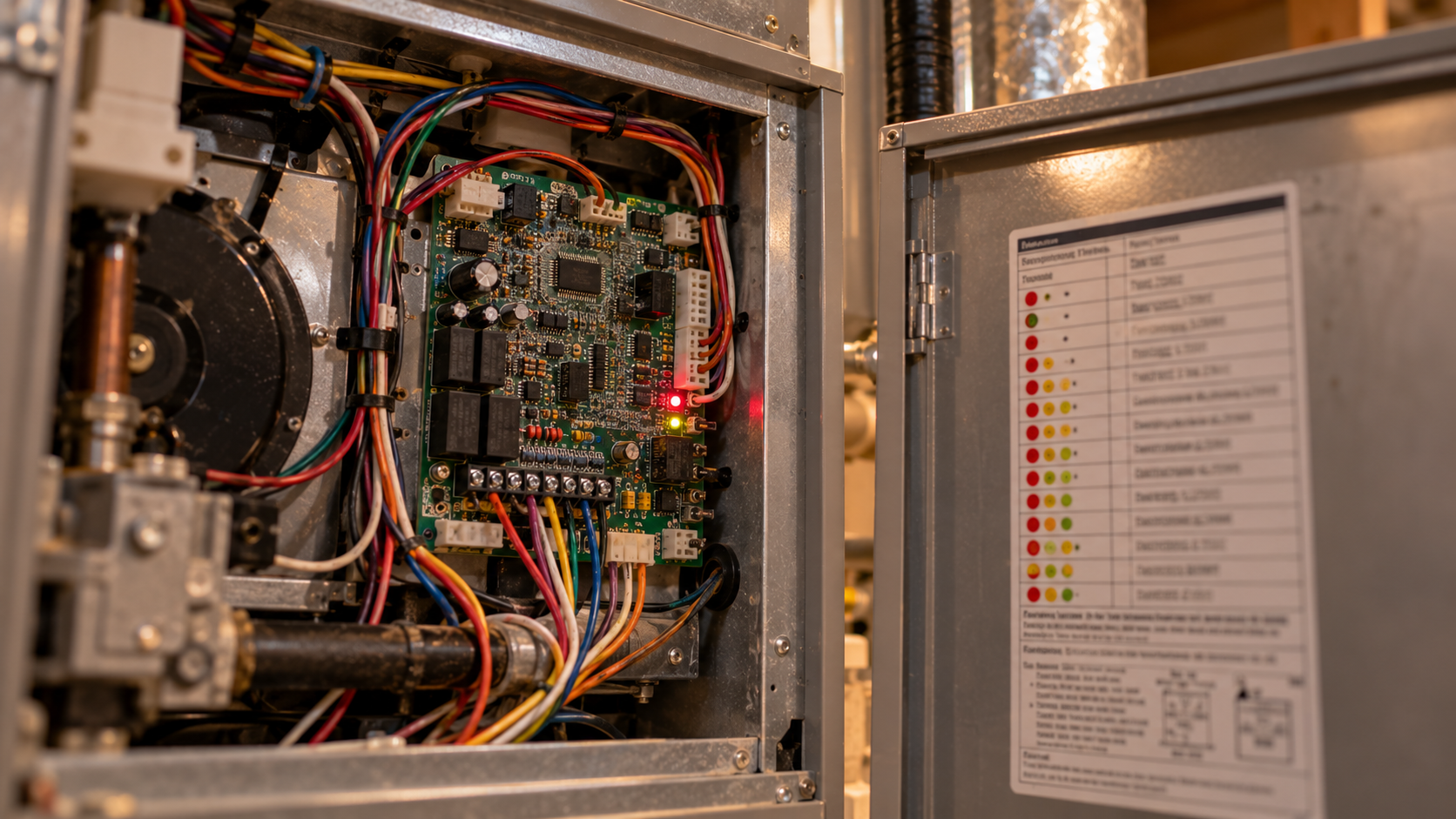
The furnace has stopped, and through the little viewport in the blower door there is an LED blinking a pattern. Three flashes, a pause, three flashes again. The obvious next step is to search "furnace 3 flashes" and start buying parts.
That search is where a lot of money gets wasted, because flash codes are not standardized. Three flashes on one manufacturer's board means an open pressure switch. On another it means a limit circuit fault. On a third it means something else entirely. Applying the wrong brand's chart is the single most common way this diagnosis goes wrong, and it usually ends with the wrong part installed in a furnace that still does not run.
Find Your Chart First
Every manufacturer prints the correct code chart for that specific board, and it is almost always within arm's reach of the furnace:
- Inside the blower compartment door. The most common location — a label listing each flash pattern and its meaning.
- On the control board itself, silkscreened next to the LED.
- In the installation manual, which is frequently tucked into a sleeve inside the cabinet.
Codes can also differ between board generations from the same manufacturer, so the chart that belongs to the furnace in front of you is the only one worth trusting. Photograph it before anything gets disconnected.
Reading the LED Correctly
Miscounting the pattern is almost as common as using the wrong chart. A few things that trip people up:
- Watch several full repetitions before counting. Boards insert a longer pause between groups, and starting mid-sequence gives the wrong number.
- Flash speed carries meaning. Many boards distinguish a slow flash from a rapid one, and the two mean different things even at the same count.
- Steady on or a slow heartbeat usually means normal. A board quietly pulsing with no fault is reporting that it is fine — not every blinking light is an error.
- Some boards use two LEDs, where the combination matters rather than either one alone. Others use color, and newer boards may show a two-character digital code instead.
- Continuous rapid flashing often indicates a board-level or power problem rather than a numbered fault.
What the Fault Categories Actually Mean
Although the flash counts differ between brands, the underlying fault categories are consistent. Once you have translated the code using the right chart, it will land in one of these:
| Fault Category | What to Actually Check |
|---|---|
| Pressure switch open / draft fault | Condensate drain, flue and intake blockage, sensing hose, inducer output — the switch itself last |
| Flame not sensed / flame lost | Flame sensor contamination, ground path, line polarity |
| Limit circuit open | Filter, blower wheel, closed registers, return sizing — airflow before the switch |
| Ignition lockout / failed ignition | Ignitor, gas supply, gas valve signal |
| Rollout switch open | Stop. Blocked flue, failed inducer, or heat exchanger — needs a combustion inspection |
| Low flame signal | Sensor cleaning and ground verification before replacement |
| Reversed polarity / no ground | Branch circuit wiring and the furnace ground connection |
| Internal board fault | The board — after confirming power and the low-voltage fuse |
The Polarity Code Worth Knowing About
This one surprises people. Flame rectification — the method the board uses to confirm a flame exists — depends on correct line polarity and a solid ground, because the circuit relies on current flowing in one direction through the flame to the grounded burner.
If hot and neutral are reversed at the outlet or junction, or the furnace ground is loose or missing, the board cannot sense flame even when the burners are clearly lit. The symptom looks identical to a dirty flame sensor, and a new sensor will not fix it. Many boards flash a dedicated code for this condition specifically because it causes so much confusion.
Before Condemning the Board: Check the Fuse
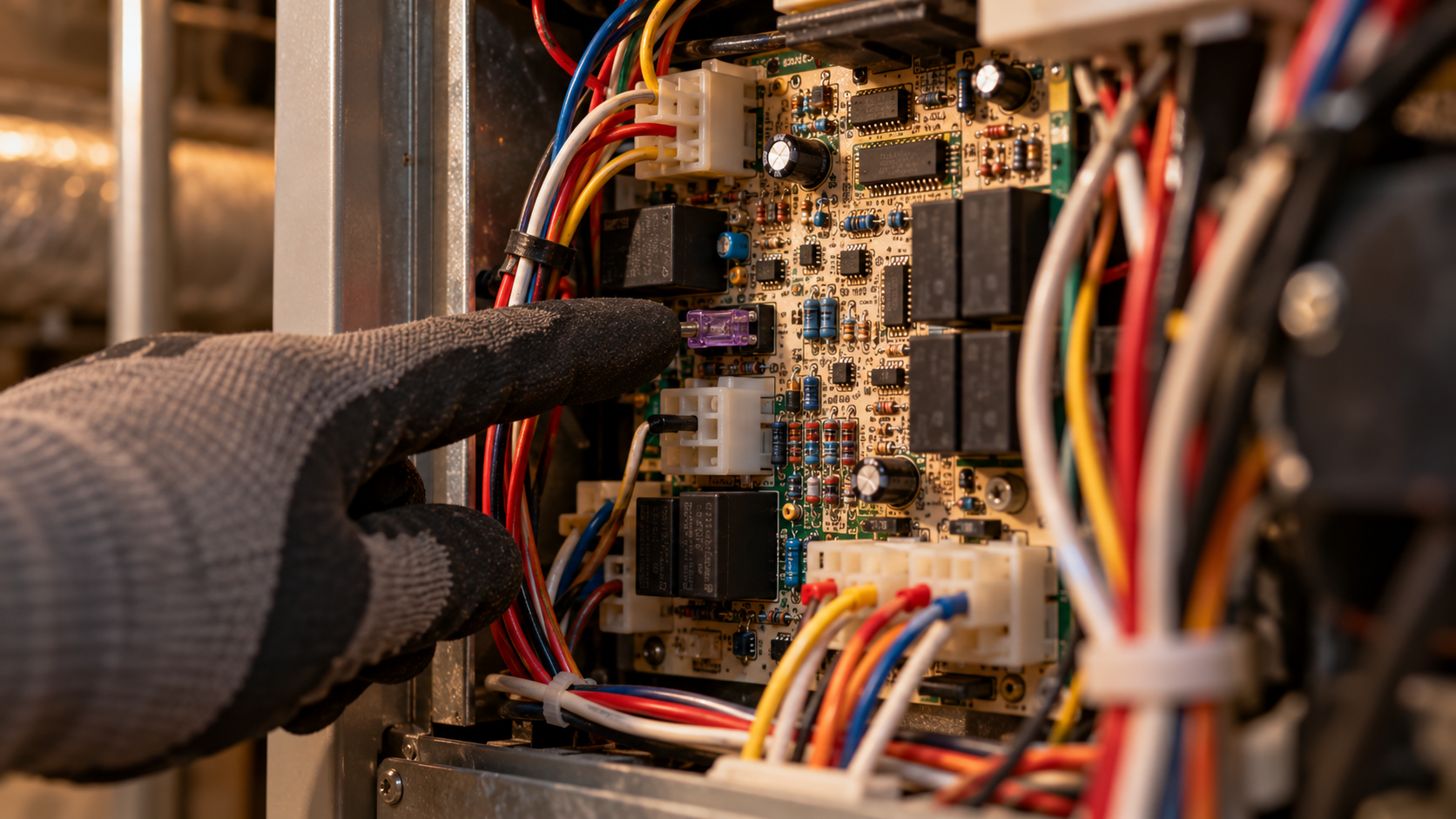
Most furnace control boards carry a small automotive-style blade fuse protecting the 24V circuit. When it blows, the board goes completely dark — no LED, no response to the thermostat, nothing. It looks exactly like a dead board, and it is a part that costs almost nothing.
Two things worth knowing about it: a blown low-voltage fuse is usually caused by a short in the thermostat wiring or at a connected accessory, so replacing the fuse without finding that short just blows the new one. And a transformer that has failed produces the same dark board, so both the fuse and the transformer's 24V output should be verified before concluding the board is at fault.
When the Board Genuinely Is the Problem
Control boards do fail, and these are the signs that point at the board rather than through it:
- Visible damage — scorch marks, burned traces, melted connector housings, or a bulged component on the board
- Corrosion, which shows up on boards in humid spaces or where condensate has dripped onto them
- Correct inputs, no output. 24V present, thermostat calling, all safeties closed — and the board still does not energize the inducer or ignitor
- A relay that chatters or will not pull in with proper control voltage present
- No LED at all with confirmed 24V and an intact fuse
- Rodent damage, which is more common than most people expect in attic and crawlspace installations
Pro Tip for Contractors: Photograph the wiring harness and the code label before pulling a board, and label anything ambiguous. Replacement boards frequently ship with a slightly different terminal layout or jumper configuration than the original, and the installation sheet assumes you know where every wire started. Five seconds with a phone camera prevents a long afternoon.
Lockouts and the Reset Trap
Most boards attempt ignition a fixed number of times — commonly three — before entering lockout and refusing to try again. Depending on the board, that lockout clears after a set period, or requires cycling power at the breaker or taking the thermostat out of the heating call.
Resetting it brings the heat back temporarily, and that is the trap. The lockout is deliberate: the board counted repeated failures and stopped. Clearing it without addressing the cause means the furnace keeps attempting ignition against an unresolved fault, which at best consumes ignitor life and at worst keeps cycling gas into a system that cannot light it.
Reset once to confirm the symptom. After that, the code is telling you something that needs fixing.
Matching a Replacement Board
Boards are among the least forgiving parts to substitute. Match:
- The OEM part number, or a documented cross-reference specifically listing your furnace model
- Terminal layout and connector types — physical compatibility is not implied by electrical compatibility
- Staging and blower control — single-stage, two-stage, and variable-speed ECM boards are not interchangeable
- Jumper and DIP switch settings, which configure timing and blower speed and must be set to match the original
Texpert Deals stocks furnace control boards, ignition controls, 24V transformers, and sensors for the faults the codes point to.
Frequently Asked Questions
Why does my flash code mean something different online than on my furnace?
Because the site you found was written for another manufacturer, or another generation of board from the same manufacturer. The label inside your blower door is the authoritative chart for your equipment.
My furnace board has no light at all. Is it dead?
Not necessarily. Check the low-voltage blade fuse on the board and the transformer's 24V output first — both produce a completely dark board and both are far cheaper than a control board.
Can I just keep resetting the breaker to clear the lockout?
It will restore heat briefly, but the lockout exists because the board detected repeated failures. Repeated resets wear the ignitor and leave the underlying fault in place. Reset once to observe the behavior, then diagnose it.
Does a code always mean a part has failed?
No. Most codes report a condition rather than a component. A pressure switch code usually means draft is inadequate, not that the switch is broken. A limit code usually means airflow is restricted. The named device is often the one doing its job correctly.
Is it safe to replace a control board myself?
The physical swap is straightforward for someone comfortable with wiring. The risk is upstream: a board replaced because of a misread code leaves the real fault in place, and a board that fails again quickly usually indicates a short or a voltage problem that caused the first failure. If the code points to rollout, combustion, or anything gas-related, that part belongs with a licensed technician.
Final Thoughts
Read the chart on your own furnace before searching the flash count. Watch several full cycles to count it correctly. Then treat the code as a pointer to a condition rather than a verdict on a part — most of them name a safety device that is reporting a problem somewhere else in the system. And before condemning the board, check the fuse and the transformer.
Browse furnace control boards and ignition controls, or request a wholesale quote for heating season stock.