Heat Pump Iced Up? Some of That Is Supposed to Happen
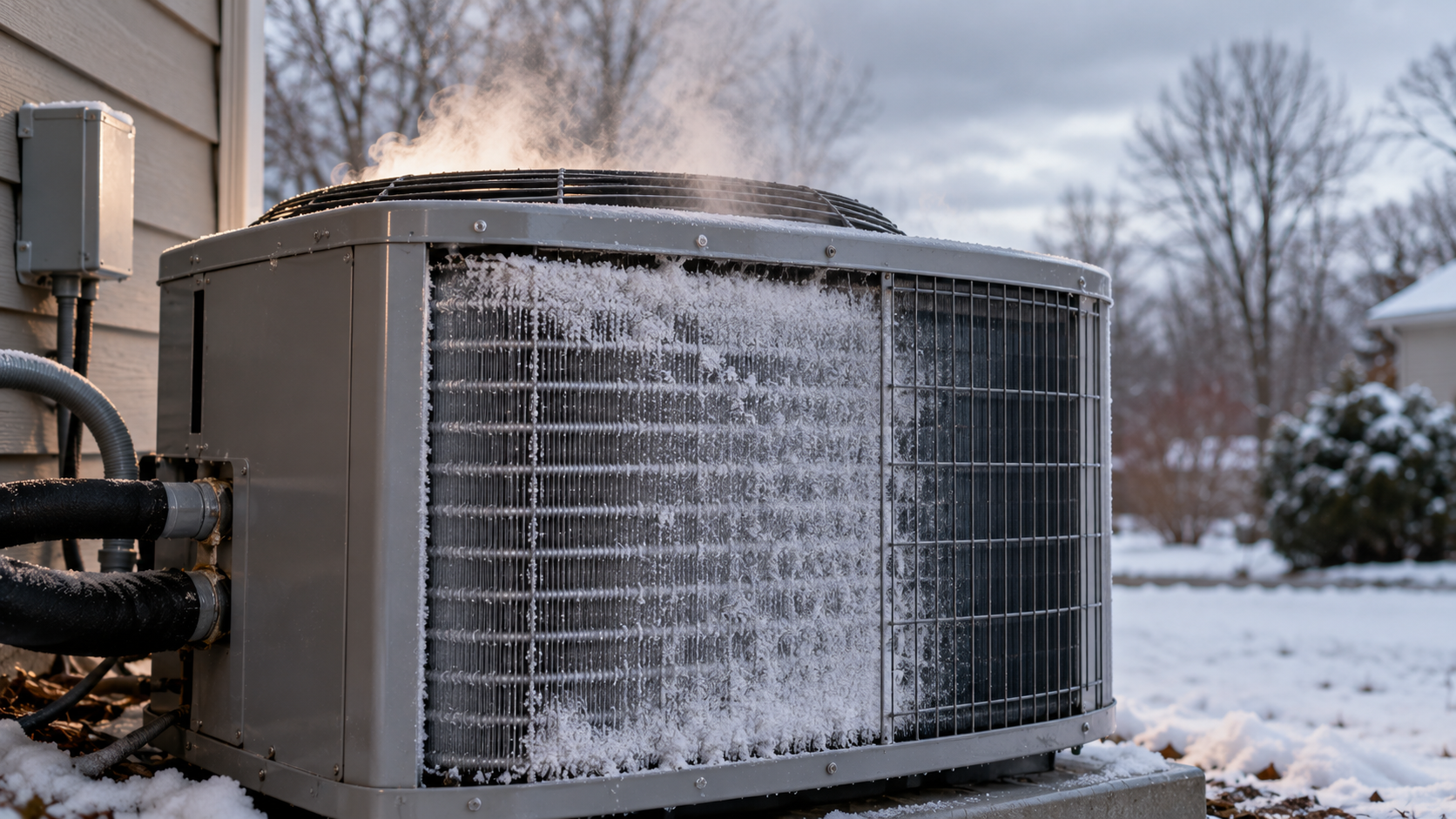
A homeowner walks past the outdoor unit on a cold January morning and finds it frosted over, venting what looks like smoke, and making a noise it has never made before. The reasonable conclusion is that something has broken.
Most of the time nothing has. A heat pump in winter does several things that look like failure and are in fact the equipment working exactly as designed. Knowing where that line sits saves a service call on one side and prevents an expensive compressor failure on the other.
Why a Heat Pump Frosts Up at All
In heating mode the outdoor coil is doing the opposite of what it does in summer — it is absorbing heat from outdoor air, which means the coil itself has to be colder than the air around it. When that coil surface drops below freezing and there is any humidity in the air, moisture condenses on the fins and freezes.
Frost is therefore not a malfunction. It is the unavoidable consequence of pulling heat out of cold, damp air, and every heat pump is built with a defrost system specifically because the manufacturer knew it would happen.
What the Defrost Cycle Actually Does
When the control decides the coil needs clearing, it does something counterintuitive: it briefly runs the system in cooling mode. The reversing valve shifts, the outdoor coil becomes the hot side, and the frost melts off. The outdoor fan shuts off during this so the heat stays concentrated at the coil instead of being blown away.
That sequence produces all the alarming symptoms at once:
- Steam rolling off the unit. Melted frost hitting a hot coil in cold air. It looks like smoke and is just water vapor.
- A loud whoosh or hiss. The reversing valve changing position. Startling the first time, entirely normal.
- The outdoor fan stopping while the compressor keeps running. Deliberate, for the reason above.
- Cooler air from the indoor vents. The system is momentarily in cooling. Most setups energize the auxiliary heat during defrost to offset this, which is also why the electric bill is higher in deep cold.
- Water or a patch of ice under the unit. The melt has to go somewhere.
A defrost cycle typically runs a few minutes — up to roughly fifteen on some systems — and then the unit shifts back to heating on its own. Boards enforce a maximum duration, so it should always end by itself.
Normal Versus Not Normal
| What You See | Verdict |
|---|---|
| Light white frost on the coil fins | Normal in cold, damp weather |
| Steam rising during a brief cycle, then clearing | Normal — that is defrost working |
| Whooshing sound a few times a day | Normal reversing valve operation |
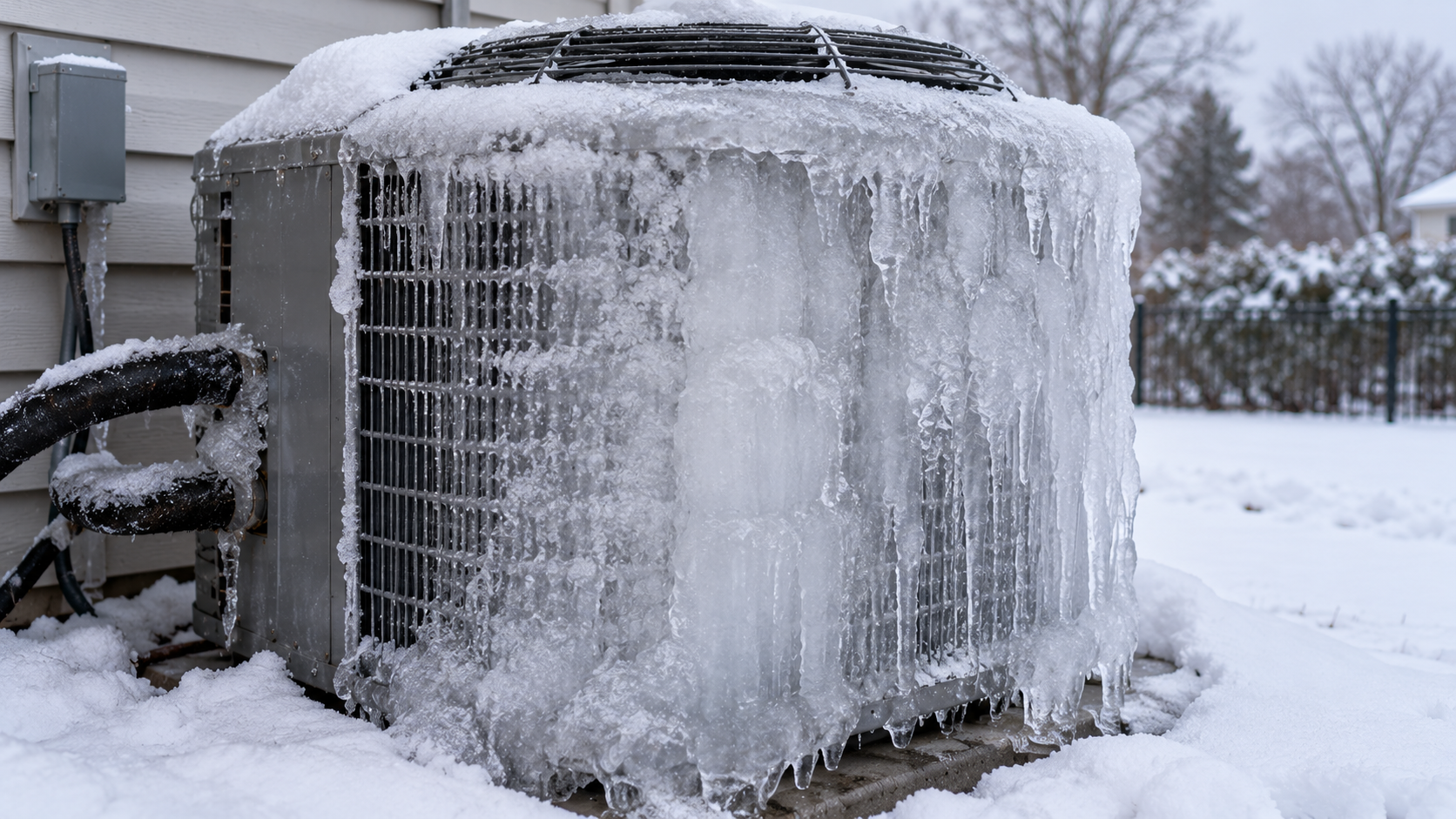
| Solid ice encasing the coil, fan blades, or whole cabinet | Not normal — defrost is not completing |
| Ice still there hours later across several cycles | Not normal |
| Iced over and no heat indoors | Not normal |
| Ice on top of the unit or over the fan grille | Usually water from above, not frost from operation |
| Defrosting constantly, or never at all | Control or sensor fault |
The simplest test a homeowner can apply: frost that comes and goes is the system working. Ice that accumulates and stays is the system losing the fight.
Why Defrost Fails
When ice wins, it is usually one of these:
- A failed defrost control board. The board decides when to initiate and terminate defrost. If it never initiates, frost simply accumulates until the unit is encased.
- A bad defrost thermostat or coil sensor. The control relies on coil temperature to know when to start and when to stop. A failed sensor produces one of two opposite symptoms — never defrosting, or defrosting constantly and wasting energy on cycles the coil does not need.
- A reversing valve not shifting. Either the valve itself is stuck or its solenoid coil has failed. Without the shift there is no heat at the outdoor coil and nothing melts.
- Low refrigerant charge. An undercharged system runs the coil colder than it should, which builds frost faster than a healthy defrost cycle can clear. Low charge means a leak, so topping it off is a temporary measure rather than a repair.
- A dirty outdoor coil. Debris and matted fins cripple heat transfer in both directions, accelerating frost and hampering defrost.
- Outdoor fan motor failure. Required for normal heating operation even though it stops during defrost.
- Blocked drainage under the unit. This is the one that produces ice building upward from the base. Each defrost releases water that cannot drain, so it refreezes and the next cycle adds to it until the bottom of the coil is buried.
- Water from above. A leaking gutter, roof runoff, or snow sliding off a roof onto the unit creates ice that has nothing to do with the refrigeration cycle. The clue is ice on top of the cabinet and over the fan rather than on the coil face.
Pro Tip for Contractors: On a repeat icing complaint, check the unit's elevation above grade and its drainage before condemning the defrost board. A pad that has settled, a unit set too low, or a base pan drain plugged with leaf debris will re-ice a system with a perfectly functional control — and a replaced board that ices again a month later is a hard conversation.
What to Do With an Iced-Up Unit
If a unit is already encased:
- Switch the thermostat to Emergency or Auxiliary Heat. That stops the heat pump, keeps the house warm on backup heat, and lets the ice thaw without the compressor fighting it.
- Use warm water if you need to speed it up — never boiling. Thermal shock and component damage are both real risks with very hot water.
- Never chip or pry at the ice. This is the one that turns a modest repair into a major one. Coil fins and refrigerant tubing are thin, and an ice pick, screwdriver, or shovel will puncture the circuit. Refrigerant loss plus a coil repair is enormously more expensive than the original fault.
- Clear snow and debris from around and under the unit, and make sure nothing above it is dripping onto it.
- Note what the ice looked like before thawing — coil face, base, or top. That detail genuinely narrows the diagnosis.
Choosing Replacement Defrost Components
When the fault is in the defrost control, match:
- The OEM part number — defrost boards are model-specific and their timing logic differs between manufacturers.
- Defrost interval and control type — older time-and-temperature boards use fixed intervals, while demand-defrost controls measure coil-to-ambient differential. They are not interchangeable.
- Sensor type and termination temperature for defrost thermostats and coil sensors.
- Coil voltage on a reversing valve solenoid.
Texpert Deals stocks defrost timers, control boards, and sensors, along with condensing units for systems past the point of repair.
Frequently Asked Questions
Is steam coming off my heat pump a problem?
No. It is melted frost evaporating off a hot coil during a defrost cycle. If it clears within a few minutes and the unit returns to normal heating, that is the defrost system doing its job.
How often should a heat pump defrost?
It varies with temperature and humidity — a cold damp day legitimately requires more cycles than a cold dry one. Defrosting every half hour in mild, dry weather suggests a sensor or control problem rather than genuine frost.
Why does cold air come from my vents sometimes in winter?
During defrost the system is briefly in cooling mode, so the indoor coil is not producing heat. Auxiliary heat usually masks it, but a short spell of cooler air coinciding with steam outside is expected.
Should I cover my heat pump in winter?
No. The outdoor unit needs free airflow to extract heat, and covering it restricts that and can trap moisture. Keep the area around and above it clear instead.
Can I pour hot water on an iced-up unit?
Warm water, yes. Boiling water, no — it risks thermal shock and component damage. And never use any tool to break ice off the coil; a punctured refrigerant line is far more expensive than the fault that caused the ice.
Why is my power bill higher when it is very cold?
Auxiliary heat. Below a certain outdoor temperature the heat pump cannot meet the load alone, so electric resistance heat supplements it — and it also runs during each defrost cycle. Higher consumption in deep cold is expected behavior, not a fault.
Final Thoughts
Frost that appears and clears, steam during a short cycle, and a periodic whoosh from the outdoor unit are all signs of a heat pump operating correctly in winter. Solid ice that persists through multiple cycles is not — and the cause is usually the defrost control, a coil sensor, the reversing valve, low charge, or water that has nowhere to drain. Switch to emergency heat, let it thaw, and note where the ice formed before anyone starts replacing parts.
Browse defrost controls and heat pump components, or request a wholesale quote for heating season stock.