Blower Motor vs. Condenser Fan Motor: How to Tell Which One Failed
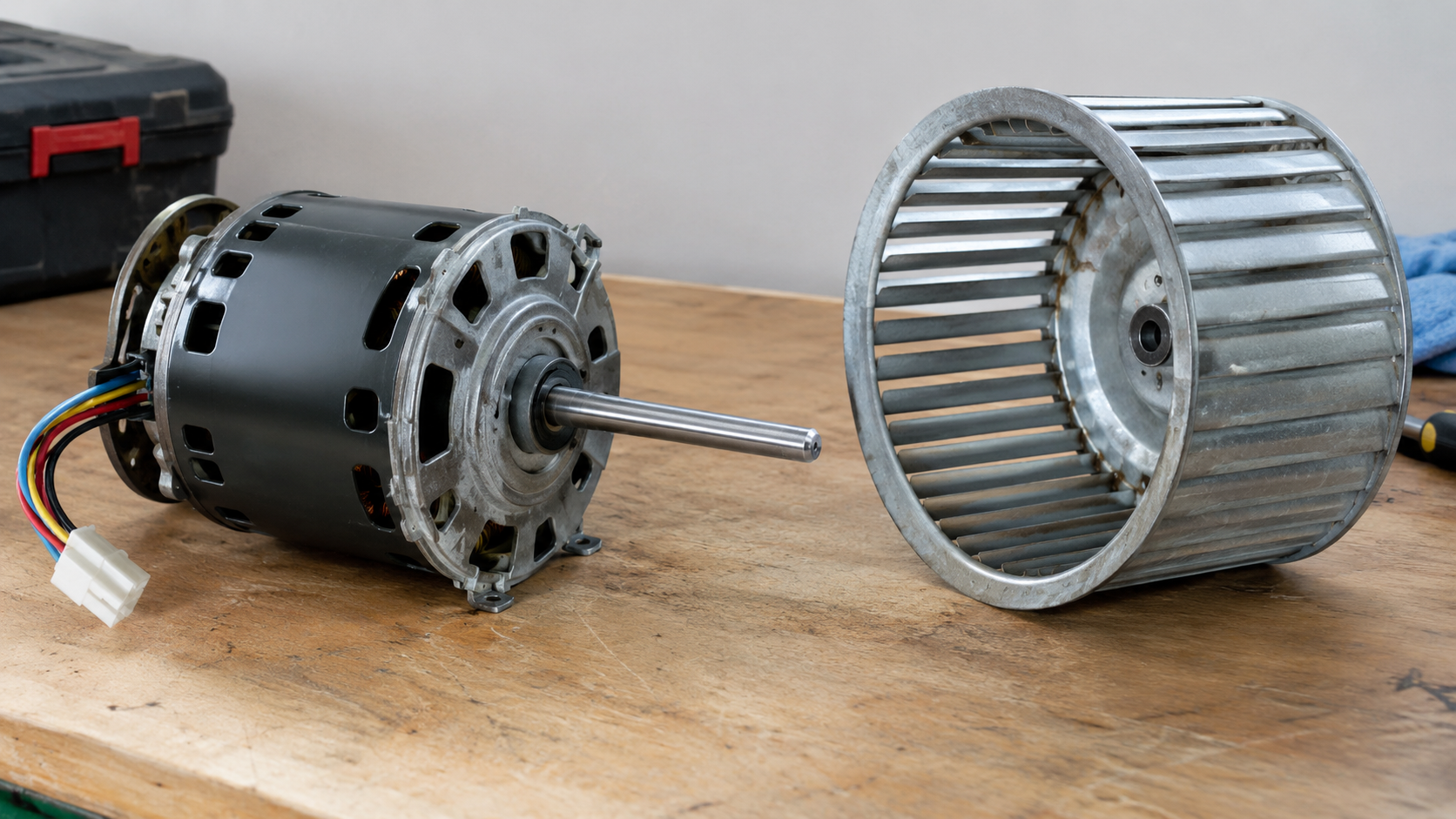
Two motors keep a central air system moving air — one indoors, one outdoors — and when either one fails, the result looks a lot like "my AC isn't working." Because both are motors, both can hum, buzz, or go silent when they fail, and it is easy to order the wrong replacement without knowing which one actually stopped. Here is how to tell a failed blower motor from a failed condenser fan motor before you buy.
What Each Motor Actually Does
- The blower motor lives indoors, inside the air handler or furnace. It pushes air across the evaporator coil (or heat exchanger, for heating) and out through the ductwork into the house. This is the motor responsible for how strong the airflow feels at every vent.
- The condenser fan motor lives outdoors, inside the condenser unit. It pulls air across the condenser coil to release the heat the refrigerant absorbed from inside the house. Without it, the system has nowhere to dump that heat, and cooling stops even though everything else is running.
They work as a team — indoor airflow and outdoor heat rejection — but they fail independently, and each failure produces a different pattern.
How to Tell Them Apart
Signs the Blower Motor Failed
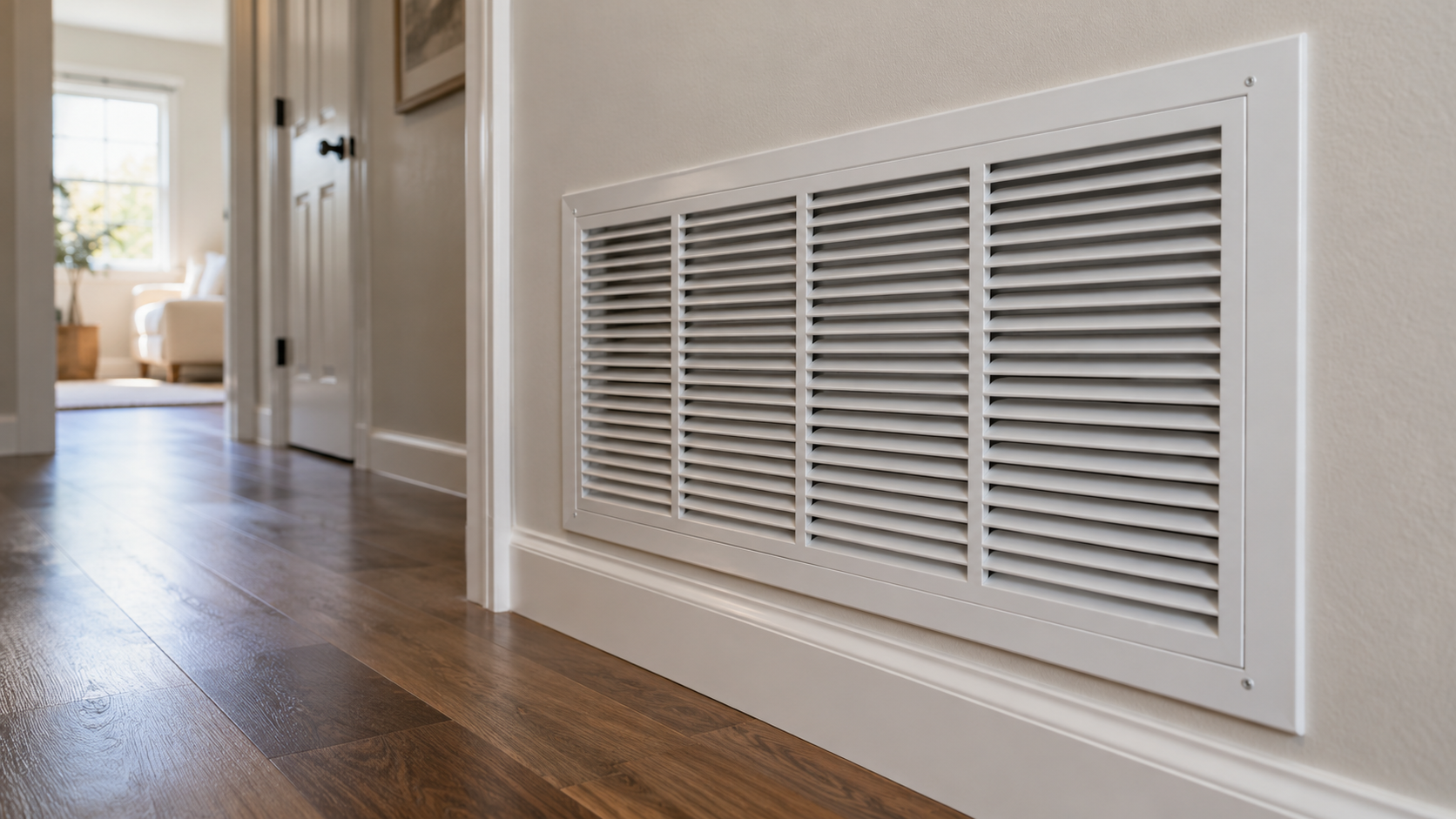
- Weak or no airflow at the vents, even though the outdoor unit sounds normal
- The outdoor unit is running, but the house never cools — because nothing is moving air across the indoor coil
- Grinding, rattling, or squealing from the indoor air handler or furnace closet
- A burning smell from the indoor unit
- The evaporator coil freezing over from lack of airflow across it
Signs the Condenser Fan Motor Failed
- The outdoor unit hums or buzzes, but the fan blades are not spinning
- Indoor airflow feels normal, but the air is warm instead of cool
- The compressor may still be running — you can sometimes hear it — while the fan sits still
- The system shuts itself off on high-pressure protection after running for a few minutes, because heat has nowhere to go
- Visible debris, leaves, or a seized bearing preventing the outdoor fan blades from turning
The simplest way to separate them: check where the airflow problem is happening. Weak or missing air at the vents points to the blower motor. Normal indoor airflow that just isn't cold, paired with a stalled outdoor fan, points to the condenser fan motor.
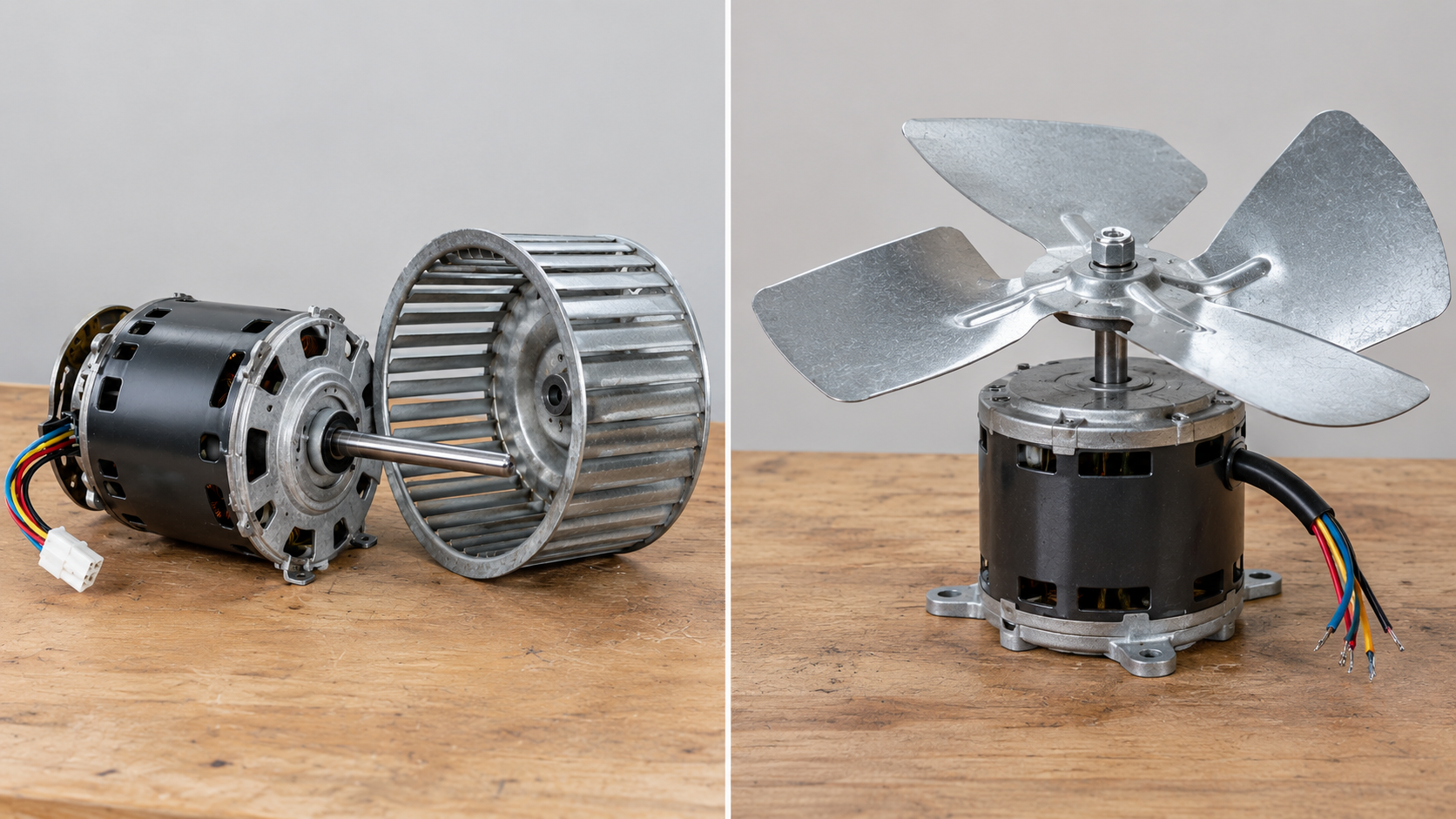
Side-by-Side Comparison
| Feature | Blower Motor | Condenser Fan Motor |
|---|---|---|
| Location | Indoor air handler or furnace | Outdoor condenser unit |
| Job | Pushes conditioned air through the ductwork | Pulls air across the condenser coil to release heat |
| Typical Failure Symptom | Weak or no airflow at the vents | Normal indoor airflow, but warm; outdoor fan not spinning |
| Risk If Ignored | Frozen evaporator coil, overheated furnace components | High-pressure shutdowns, compressor overheating |
| Common Failure Cause | Worn bearings, capacitor failure, dirty blower wheel | Worn bearings, capacitor failure, debris jam |
Why Both Failures Can Look Electrical
Both motors rely on a run capacitor to start and stay running, so a motor that "hums but won't spin" is not always the motor itself — it is sometimes a failed capacitor starving it of starting torque. Before ordering a new motor, it is worth ruling out the capacitor first, since it is the far cheaper part and a surprisingly common root cause behind what looks like a dead motor. Our AC Capacitor Symptoms guide covers exactly how to check it, and our AC Contactor vs. Capacitor guide covers the other common culprit behind a motor that won't start at all.
Pro Tip for Contractors: Before condemning a motor that hums but won't turn, spin the fan or blower wheel by hand (with power off) — if it spins freely, suspect the capacitor first; if it feels stiff or grinds, the motor bearings themselves have likely failed.
Ordering the Right Replacement
Once you've confirmed which motor failed, match these specs before ordering:
- Horsepower and voltage — must match the original nameplate rating exactly.
- Rotation direction (CW or CCW) — motors are direction-specific; installing the wrong rotation will move air backward or not at all.
- Speed type — single-speed, multi-speed, or variable-speed (ECM) motors are not interchangeable without matching the original control type.
- Mounting configuration — frame size and shaft length need to match the housing it's going into.
Texpert Deals stocks blower motors and condenser fan motors across the horsepower and voltage ranges most residential and light commercial systems use, ready to ship same-day.
Frequently Asked Questions
Can a bad capacitor be mistaken for a bad motor?
Yes — a motor that hums but won't spin is one of the most common misdiagnoses in the trade. A weak capacitor can't supply enough starting torque, which produces the exact same "humming but not turning" symptom as a seized motor. Checking the capacitor first can save an unnecessary motor replacement.
Why is my indoor air warm but blowing normally?
This points toward the condenser fan motor. The blower is still moving air, but if the outdoor fan has stopped, the system can't release heat from the refrigerant, so the air coming through the vents is no longer being properly cooled.
How long do blower and condenser fan motors typically last?
Most motors last 10–15 years under normal use, though dirty coils, restricted airflow, and repeated hard starts from a weakening capacitor can shorten that significantly.
Do I need a variable-speed (ECM) motor if my original was one?
Generally yes. ECM motors use a built-in control module that communicates with the system's control board, and swapping to a standard PSC motor can affect airflow staging and, on some systems, trigger fault codes.
Final Thoughts
Weak airflow at the vents points to the blower motor. Normal airflow that isn't cold, paired with a silent outdoor fan, points to the condenser fan motor. Either way, it's worth ruling out the capacitor first — it's the cheaper part and a common false alarm for both.
Browse blower motors and condenser fan motors, or request a wholesale quote for volume orders.